film

Old School Review: “Le Doulos” (1962)

*Warning: There will be spoilers in this review in order to more effectively discuss the film.*

Written and directed by Jean-Pierre Melville and adapted from a novel written by Pierre Lesou, “Le Doulos” is another criminal caper from Melville that examines the paranoia and uneasy friendships between gangsters and thieves. This was an interesting film that effectively utilized confusion and intentionally misleading filmwork to hide the true intentions of the characters involved. It reminded me a lot of “Inherent Vice” or “The Big Lebowski” where the plot can seem fuzzy and incoherent, but the magic comes through when looking back at the film as a whole. This film isn’t exactly about the double crossings, who did what at which location or even at what time, this film feels a bit looser than say “Bob le Flambeur” in its details. “Le Doulos” is more concerned with the look of a gangster in a trenchcoat at night, in the rain, with a snap-brim hat and a slowly burning cigarette hanging from the corner of the shadowy figure’s mouth. That’s not to say the character work isn’t good fun, but it all feels like mere dressing for the actors’ to look cool and be gangsters that are both aloof, yet highly invested in their code of criminal honor.

Maurice Faugel (Serge Reggiani) has just gotten out of prison after serving a six year sentence for a previously botched job, and he’s out for revenge. Maurice makes his way to Gilbert’s (René Lefèvre) place initially. While Gilbert, the fence, and Maurice were once close friends, Maurice found out that Gilbert had his girlfriend killed after he was sent to prison just to make sure she wouldn’t talk to the cops, and thus, Gilbert had to go. Maurice quickly takes the money, jewels, and Gilbert’s gun and buries it all next to a lamppost not far away from the murder scene. Maurice then moves on to a small and uncomplicated robbery in a wealthy suburb and gets in contact with his old friend, Silien (Jean-Paul Belmondo) who helps provide a few essential tools for the low level heist. Silien’s burden in the underworld of crime is his reputation for being a “doulos” (or informant) for his friendship with inspector Salignari (Daniel Crohem). Unfortunately for Maurice and his partner in crime, Remy (Philippe Nahon), their burglary was interrupted by the police and ended with a shootout in which both Remy and Inspector Salignari are shot dead with Maurice only getting a bullet in the shoulder as he ran for his life. This results in the best cinematography of the film in which Maurice darts away from the shootout scene and the camera stays pointedly fixed on him as it keeps pace with him which makes the world racing by seem all that more frantic and fuzzy. Maurice runs until he collapses and a mysterious car pulls up before a cut to Jean’s (Philippe March) apartment, a friend of Maurice’s, in which neither he nor Jean’s wife Anita (Paulette Breil) knows how he got there. There’s a few scenes in which it’s not initially easy to identify if we’re looking at Silien or Maurice at times as the characters are dressed similarly in the stereotypical Noir film ‘outfit‘, and that plays very much into the assumptions the audience builds about Silien throughout the first half of the film. We see Silien tie up and interrogate Maurice’s current girlfriend Thérèse (Monique Hennessy) and tie her to a radiator at one point, we also see him find and take the money, jewels, and gun that Maurice buried at the beginning of the film, and we also get the recurrent theme of the gangster performing a few last tasks before ‘getting out of the game for good’. Due to his plans to get out of the underbelly of Parisian crime, we get a scene with Silien courting the girlfriend, Fabienne (Fabienne Dali), of a notorious local gangster Nuttheccio (Michel Piccoli). She wants out from under the thug’s thumb, so she agrees to a plan formed by Silien. During this time Maurice is furious at Silien as he thinks that his friend could be the only one to have sold him out to the cops, and after the cops previously shook down Silien earlier in the film Maurice was fingered for Gilbert’s death but he couldn’t be pinned down for it so he was returned to jail for refusing to give up information. While in prison Maurice meets Kern (Carl Studer), whom he hires to kill Silien for this transgression.
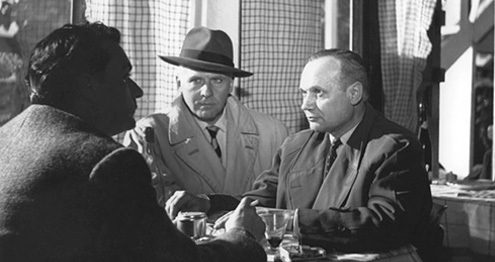
So, while Maurice is in prison, Silien enacts his plan with Fabienne. They lure Nuttheccio and his business partner Armand (Jacques De Leon) into coming to Nuttheccio’s office where Silien lay hidden in darkness and kills them but not before getting Nuttheccio to open his safe so Silien can plant the money, jewels, and Gilbert’s gun to make it look like they killed each other over the spoils accrued from Gilbert’s death. Fabienne backed up the account of their deaths and Maurice was set free. However, since Maurice still believed that Silien sold him out in the first place, he , Jean, and Silien all meet at a cafe where Silien explains himself, and how the real informant was actually Thérèse- who was mysteriously killed by Silien earlier in the film when he pushed her in a rolling car off a cliff. In truth, Silien was actually looking out for Maurice the whole time. His only two friends in the world were inspector Salignari and Maurice, whom Silien went to great lengths to help out, after all, he had to uphold his honor as a fellow criminal. Silien announces his intent to move out to the country with Fabienne, and then happily departs the cafe. However, it dawns on Maurice that he still has a hit out on Silien and rushes back to his friend’s place to tell Kern that the hit is off. He beats Silien to the house and walks through the doors only to be mistaken by Kern for Silien and is shot immediately. Silien arrives shortly after and finds Maurice dying on the floor who warns him that Kern is there hiding behind the screen divider as he dies in Silien’s arms. Silien then fires into the wooden screen as Kern stumbles forward and falls to the floor- but in the flash of an eye as Silien turns back to Maurice, Kern raises his arm and shoots Silien in the back before dying. Silien stumbles, and haphazardly makes his way to a mirror before adjusting his hat and falling over dead.

This was a solid noir film, and if you’re looking to learn more about the essentials of the sub-genre then I’d highly suggest this one. It’s not the most easily digestible Noir film out there though, if you’ve gotten a lot of the American classics down then this will be a welcome addition. However, if you have not seen a lot of Noir cinema I suggest seeking out “The Maltese Falcon”, “Chinatown”, “The Third Man”, or “Touch of Evil” first. Those will give you a great foundation before bounding deeper into this corner of film history.

Final Score: 2 cases of mistaken identity

film

Old School Review: “Bob le Flambeur” (1955)

Written by Auguste Le Breton, and Jean-Pierre Melville and directed by Melville, “Bob le Flambeur” is a French noir film from the oft described Godfather of the infamous New Wave filmmakers who would burst onto the scene with radical new filmmaking techniques in just a few short years. Most of the French films I have seen at this point haven’t quite connected with me as much as I had expected, or even hoped for. That changes with this film however. Recently I noticed that a bunch of Jean-Pierre Melville movies were set to leave the Criterion Collection’s streaming service at the end of February, and I had been meaning to check them out. There’s nothing like a fast approaching deadline to give you a sense of focus. I must say that I loved this film, and I cannot wait to run through more of Melville’s filmography. “Bob le Flambeur” follows Bob Montagné (Roger Duchesne), a former Parisian gangster before the war, and now a well known gambler among the many nightclubs and bars of the night life in Paris. Even the cops know Bob, a man of honor and luck, he once saved the life of the local inspector (Guy Decomble) and they forged a long friendship. The owner of the corner bar, Yvonne (Simone Paris), bought the place with a loan from Bob, and with it her loyalty to him. And then there’s Paulo (Daniel Cauchy), an eager young man who hangs around, as his father was a great friend of Bob’s. We get most of our information about Bob by the way people greet and react to his presence and how they speak about Bob when he’s around and when he’s not.

We follow Bob as he moves from room to room throughout the latest hours of the night and the earliest of the morning, as the narration by Melville informs us “in those moments, between night and day … between heaven and hell.” He ends up losing most of his remaining funds, in fact throughout the whole first act Bob never seems to win at all. It isn’t until he hears about a potential heist with a score big enough to offset the risks that he begins to win at games of chance. It is here that a refresher on French vocabularly might be worthwhile; The word being “Flamber” (verb): To wager not only the money you have, but the money you don’t have. This is the epitome of who Bob is at his core. He is a gambler through and through, always rolling dice, flipping coins, and pulling the levers on a slot machine. Risk and chance are the fuel of his existence. Which is why the old gangster perks up when a friend mentions that the safe in the Casino in Deauville occasionally holds extraordinary amounts of money. They quickly begin to assess the situation and start gathering a crew of people with the essential skills and connections that could allow them to pull off this feat. It’s here that movies involving heists over the next fifty plus years have looked back upon for inspiration in the examination of a heist’s plan. Melville was aware enough of the conventions of the genre and chose to have his criminals forgo the usual charts and blueprints used to elaborate on the specifics of the plan. Instead, Melville had his crew go to detailed lengths to plan out their heist by spraying the outlines of the casino’s floorplans on an empty field and having his men walk through the steps. They also get some reconnaissance by driving around the Casino’s walls and having one of the crew accurately sketch the outlines and specific features of the building. They hire an expert safe cracker and acquire an exact replica of the safe they have to crack for practice. Which is all well and good, but I must direct your attention to the side characters who are all given adequate background information and motivations for their choices within the film. First, there’s Anne (Isabelle Corey), a young woman on the verge of falling into the clutches of the many pimps on the streets of Paris. Bob hates pimps, and he goes out of his way to make it known to Marc (Gérard Buhr), a down on his luck former gangster-turned-pimp early in the film. Unfortunately for Bob, Marc’s also dogged by the cops who will let him slide on smaller infractions if he gets them some good insider information from the criminal underworld of Paris. Anne floats around from Bob’s place (he allows her to stay if she has nowhere else to go), to several career paths, into and out of the lovesick arms of poor Paulo, and eventually back to Marc- who is denied her business as a prostitute, but given all too valuable information by accident.

In the end, Bob gets comepletely sidetracked by gambling at the casino. He almost forgets his schedule entirely, but runs out of the tables and into a gunfight. While he earned himself extraordinary wealth, he also missed the worst of the violence and gets there just in time to catch Paulo as he dies in his arms. Tragedy, sparked by an optimistic and oddly cynical note that by becoming so wealthy that he may avoid all jail time with the right lawyer for the right price. It’s one of those eternal ironies that comes through in the third act that adds just the right mix of cinematic magic to the whole affair, you see, Bob had promised his first partner in the scheme that he wouldn’t gamble until after the job had been done, but the allure of the casino was just too much for him. It’s just his nature, as the film likes to remind us. Beyond the plot, the cinematography caught me as something almost mythic in certain shots. That may seem strong, but the farther we get from the black and white films of the twentieth century, the closer that time feels to becoming as large and impenetrable in the cultural zeitgeist as say, the American West in the 1800’s. Maybe it’s just me, but I also love it when a film’s lead character travels through an environment and becomes dwarfed by the landscape, be it man-made skyscrapers or small towns, or natural like trees or mountains. Putting man on the scale of the world in your framing makes humanity seem small in comparison to the world around it- but it makes our acomplishments that much more powerful too.

If you’re looking for some good old school noir and are willing to read subtitles, I highly suggest checking this one out. For fun, try to spot all the people who aren’t smoking onscreen- once you notice it, it’s hard to miss the massive amount of people and time that smoking takes up onscreen. Otherwise, look forward to some more reviews on the films from Jean-Pierre Melville. ‘Til next time film nerds!

Final Score: 800 Million Francs

film

Old School Review: “The Hidden Fortress” (1958)

Written by Ryûzô Kikushima, Hideo Oguni, Shinobu Hashimoto, and Akira Kurosawa and directed by Kurosawa, “The Hidden Fortress” is an adventure comedy that notably inspired George Lucas in his crafting of the original “Star Wars”. The film follows two peasants, Matashichi (Kamatari Fujiwara) and Tahei (Minoru Chiaki) trying to return home after being conscripted into a regional war. They provide the levity in the film, which is more frequently in use here than the majority of Kurosawa’s work (of the films of his that I’ve seen at least). We begin the film with these two bemoaning their predicament after having gotten to the war two days late and forced to bury the dead. They wander across a desolate landscape towards home but find the border now controlled by the recently victorious kingdom, thus forcing them to find an alternate route home through separate kingdoms adjoining one another.

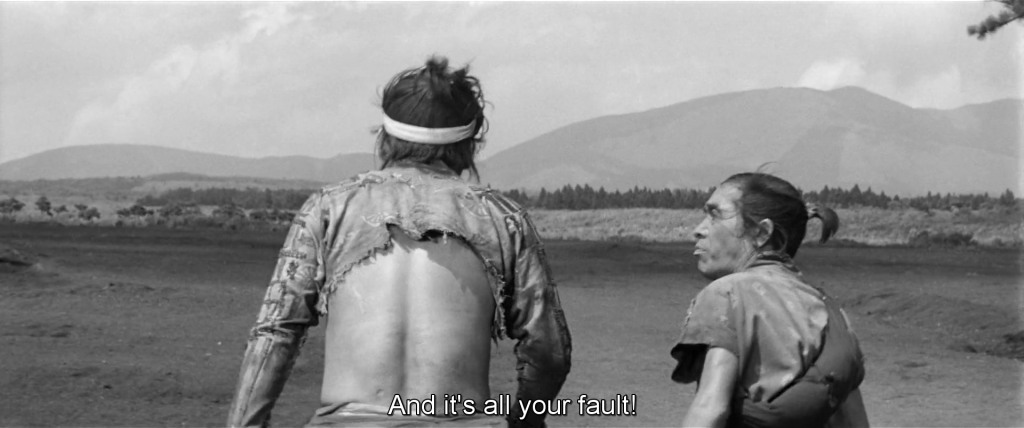
A few scenes later the two stumble across a gold bar lodged inside a wooden stick while making a fire for the night. Bewildered at their luck, Matashichi and Tahei make a mad dash in the morning to find more of the hidden gold. In their frantic efforts, which mostly consist of them bickering over how to divide the gold, they stumble into Rokurota Makabe (Toshirô Mifune), a well known general of the defeated kingdom- though they do not recognize him. After telling him their plan to travel through a neighboring region to avoid the newly established checkpoints, Rokurota recruits them to his cause through clever manipulation as he leads them to the eponymous Hidden Fortress. He keeps them busy for awhile by suggesting that the rest of the gold may be buried near the fortress. During that time he retreats to the waterfall hideout of Princess Yuki (Misa Uehara), the nobility left in power after his kingdom’s destruction. There they craft a plan alongside Izumi Nagakura (Takashi Shimura), the elder general, to use the peasants’ idea for their route and to enlist them to help carry the royal family’s remaining gold back home. They also decide to have the Princess pretend to be mute as to avoid detection as she could accidentally reveal herself through speech usually characteristic of nobility. The troupe, consisting of Rokurota, Princess Yuki, Matashichi and Tahei then depart hauling the hidden gold on their backs and in a large cart.

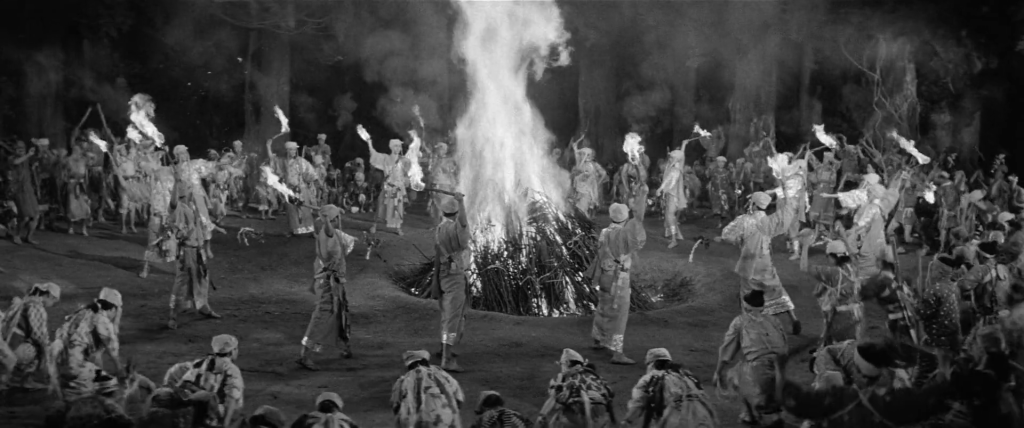
The rest of the adventure is full of high energy moments like the lance (spear?) duel between Rokurota and Hyoe Tadokoro (Susumu Fujita), a general of equivalent rank and status. There’s also quieter beats of tension like the numerous times Matashichi and Tahei create new problems for Rokurota and Yuki by either plotting to steal the gold for themselves or their general fear of getting caught with all this gold. Eventually they sneak into a procession of people marching with hordes of wood towards a fire festival nearby- thus blending into the crowd to avoid being stopped by any watchmen. There’s a lot to like in “The Hidden Fortress” so I’ll spare you all the details for your own discovery, though it is most certainly worth a watch! This film feels like a tonal standout from Kurosawa’s other works. There’s no self serious moral message or compelling heroics, or even universally relatable characters as in other films of his. This film feels most at ease with it’s premise, a high stakes energetic comedy with a sensation similar to those punchy adventure serials from American cinema from the previous two decades before this film’s release. It’s clearly crafted by a master director if you’re paying attention though. Kurosawa’s deft hand at directing and filming is on display for those analyzing shot structure and the handling of movement and blocking. In fact, there’s a scene early in the film before Matashichi and Tahei encounter Rokurota, that’s reminiscent of the ‘Odessa Steps’ scene from “Battleship Potemkin” (also reviewed on the blog @ https://wordpress.com/block-editor/post/spacecortezwrites.com/11007) in which dozens upon dozens of people descend down a huge staircase against a horde of guards with guns shooting into the crowd. There’s some question as to whether or not Kurosawa was directly homaging Potemkin, but I imagine he was aware of that uniquely important film at the very least.

If you have any interest in getting into Japanese cinema, this is an easy entry point and I highly recommend it. Especially because it will likely lead you to other excellent films by Kurosawa, or dare I say it, the work of Mizoguchi or Ozu. It’s like recent Academy Award winner Bong Joon-ho infamously said “Once you overcome the 1-inch-tall barrier of subtitles, you will be introduced to so many more amazing films.” The man couldn’t be more right. So if you’re new to foreign cinema, welcome, and if you’re a well worn visitor to the land of subtitles and a difference in perspective, welcome back! ‘Til next time film nerds!

Final Score: Two Peasants, One Princess

film

Old School Review: “Shoot The Piano Player” (1960)

*As this film is sixty years old, there will be spoilers.*

Written and directed by François Truffaut, “Shoot The Piano Player” is an adaption of the noir novel “Down There” by David Goodis. Ironically, this was Truffaut’s 2nd film after “The 400 Blows” and the second film of his I’ve seen (The first being “Breathless” which is also reviewed on this blog). This film has heartened me to the infamous French ‘New Wave’ filmmaker far more than “Breathless” did, which isn’t to say that I disliked that film, “Shoot The Piano Player” simply kept my attention far easier. Perhaps this is due to Truffaut wanting to showcase the influence American films had on his work, or because of it’s non-linear story structure that reveals character development and evolution through elaborate flashbacks. Either way, I rather enjoyed this film by Truffaut.

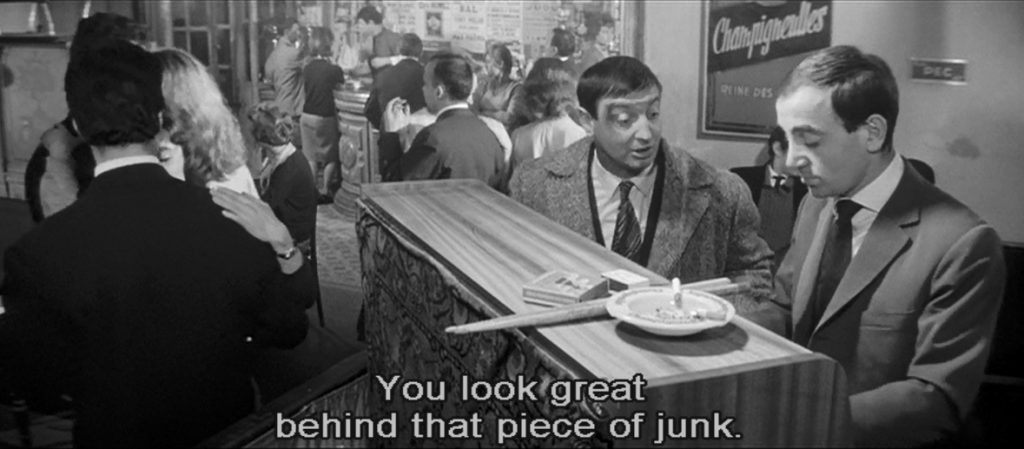
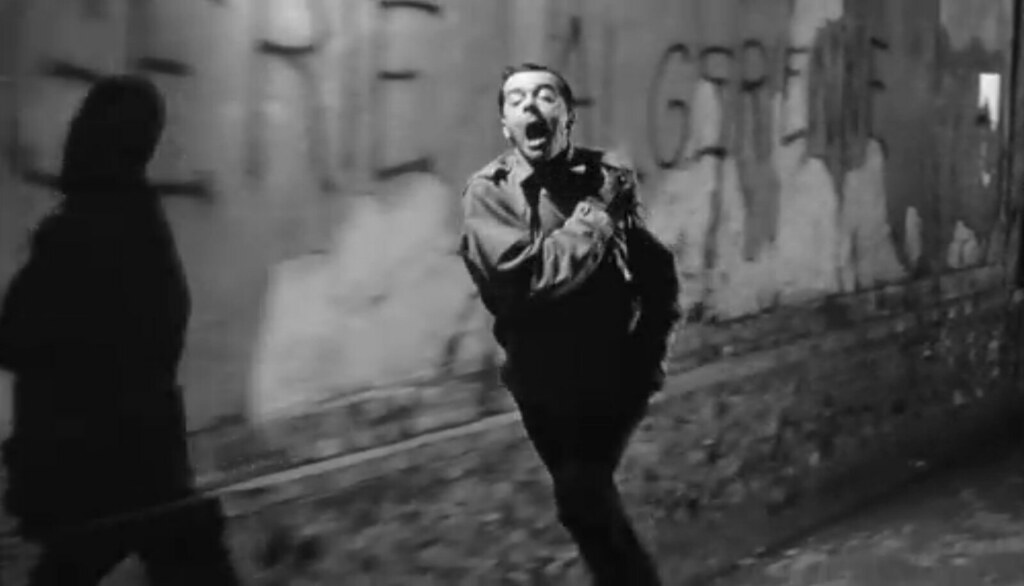
The film opens with a man in a trenchcoat being pursued for unknown reasons through the streets of Paris at night. We get a short conversation between the man and a stranger who’s helped him off his feet after a short tumble. They stride in a casual pace and ponder the intricacies of love and marriage before the stranger turns off another street and our focus rips back into a hurried flurry as our man enters a small, dingy, jazz bar filled with dancing patrons. There we discover that the man we’ve followed here is Chico Saroyan (Albert Rémy), brother of the pianist Charlie Kohler (Charles Aznavour), who is irked when Chico flippantly calls him Edouard in a teasing manner. Chico’s on the run from a couple of gangsters that he’d scammed out of their share of a heist, and they’re onto him. He pleads for Charlie’s help, but Charlie’s uninterested- he left his family behind awhile ago- but he still stalls the two thugs when they barge into the bar anyways. Eventually the two gangsters track down Charlie and the waitress Léna (Marie Dubois) from the bar, as they saw him with her later that night, and they nab both off the street at gunpoint. They escape with the help of an inquiring police officer and flee before the film takes a huge flashback that encompasses (what feels like) most of the second act. Léna then takes Charlie back to her apartment to hide out where she reveals that she always knew of his past as Edouard Saroyan, famous piano player that sold out concert halls all over Paris.

We’re then treated to a lengthy deep dive into Edouard’s past as he began practicing piano, courted a waitress, Thérèse (Nicole Berger), at a local diner and eventually married her before he got famous as a world class performer. Eventually they grow apart with the wealth and fame going to Edouard’s head as they continually fight over seemingly trivial issues that are actually clues to the much deeper issues growing between them. A few surprising reveals later and we discover the source of Edouard’s inner sadness and general melancholy towards the world around him before cutting back to the present. After they decide to quit the bar life Edouard and Léna work towards rescuing Fido (Richard Kanayan) the youngest Saroyan brother from the two gangsters. Unfortunately for them, Plyne (Serge Davri) the lummox tending the bar, has become enraged at Edouard’s advances toward Léna. A fight then breaks out between them that ends in the back alley with Edouard stabbing a knife into Plyne’s back! Though Edouard had tried to stop the fight, Plyne would not yield- the women had seen him take up such a cause and he was committed to finishing it, quite the bad luck. Thus, with blood on his hands, Edouard decides to head out to the old Saroyan farmhouse with Chico and Richard (Jean-Jacques Aslanian), the eldest Saroyan brother. It’s not long before the two gangstera arrive with Fido in tow to confront Chico and retrieve their portion of the stolen money. There’s a shootout in the snow and everything essentially gets resolved with Léna informing Edouard that the police absolved him of his crimes as multiple neighbors had seen him try to stop Plyne in the fight. It was self defense after all. Unfortunately, Léna got caught in the ensuing crossfire and didn’t make it back to Paris. Fido was reunited with his brothers though. The film ends with Edouard returning to that same dingy dive bar and sitting back down at his crummy piano to play once more, while staring blankly into space as the film fades out.

This film had a more playful edge than “Breathless”, despite carrying heavier plot points overall, but I believe this helped to buoy the film more evenly as a whole. You can definitely see the influence of American Noir films here in Truffaut’s second film, but more specifically you can feel the presence of Alfred Hitchcock clearly and knowingly. So while this is most certainly a French film in the 1960s (Multiple instances of smoking in bed, sensations of nihilism sparking into poetic manifestos before swinging back into nonchalance, and a very loose and undefinable playfulness when concerned with intimacy and sexuality), you can rest assured that the film has a destination at the end, with a more focused narrative- which might just be preference- but it worked for me! Check this one out if you can.

Final Score: 2 Gangsters

film

Old School Review: “The Evil Dead” (1981)

Written and directed by Sam Raimi, “The Evil Dead” is the quintessential archetype of the “Cabin in the Woods” style of horror films. Recently, a group of friends and I rewatched Sam Raimi’s masterpiece indie horror cult classic- and it dawned on me that I had never written about it here in the blog. There’s no time like the present they say, so, here I am. First, there will be spoilers- but I highly recommend the film if you’ve never seen it, it’s one of my all time favorite horror films. In the film, five young Michigan State University students travel through the Tennessee mountains to vacation in a remote cabin. Their journey there takes them through increasingly abandoned roads and eventually through a two-track trail deep into the forest. In a bit of unnerving foreshadowing their final descent involves crossing a rickety wooden bridge in Raimi’s 1973 Oldsmobile Delta 88, affectionately nicknamed “The Classic”.

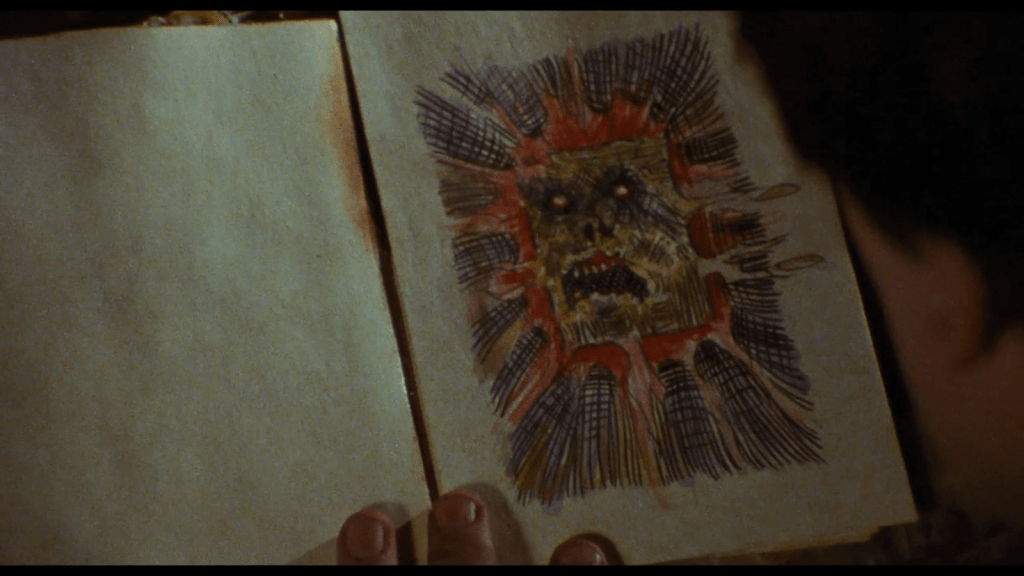
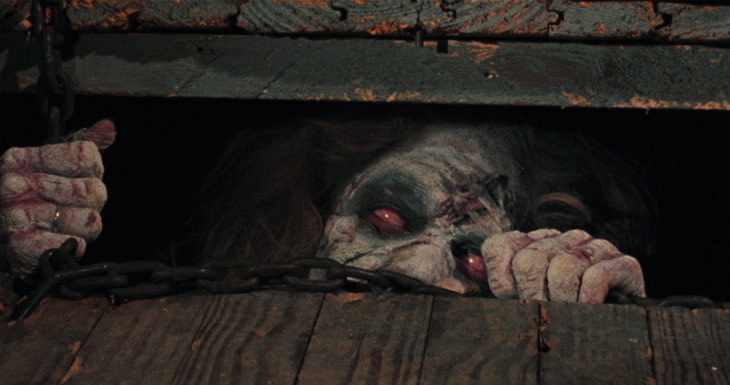
Once the group reaches the cabin, an ominous porch swing continuously slams into the side of the cabin walls until Ash (Bruce Campbell) unlocks the front door with a skeleton key ring above the door’s mantel. The five friends all settle in despite the creeping sense of an ominous force in their midst. One of the girls, Ash’s sister Cheryl (Ellen Sandweiss), is drawing the clock on the wall but becomes weakly posessed for a moment as she’s forced to frantically draw a crude rendering of the infamous Necronomicon, or “Book of the Dead”. Then shortly afterwards at dinner, the trapdoor to the cellar abruptly flies open. Ash and Scott (Richard DeManincor) investigate the occurence and wander through the basement, to which they discover a litany of bad omens in a secluded room. Daggers, bones, and a filthy book bound in human flesh and inked in blood are all on display, at which point Ash and Scott laugh at the oddity and decide to take the items upstairs for a goof. They also found an archaeologist’s tape recorder which they play at their peril. In the tape the archaeologist describes the phenomenon that they are about to experience in which ancient Sumerian rituals raise demonic spirits. Cheryl asks them to stop the tape, but Scott insists they hear the end, and when he turns the tape back on the archaeologist has begun reciting the incantations that stir and wake the slumbering demonic forces of evil, eager to posess their latest victims. Initially The Evil Dead stalk their victims from the shadows before going all out on the college students. Cheryl keeps hearing voices clamoring for her to “Join us” and eventually goes out into the woods to confront them- which is a massive mistake as the trees attack her and in one of the most disturbing scenes of the film, rape her with swarming tree branches and sticks. It’s gruesome and horrifying, but it certainly sets up this supernatural phenomenon as one of absolute Evil.

The rest of the film is the blueprint for hundreds of homages, tribute scenes, and essential structure for horror movies utilizing remote locations with teenage protagonists set against something usually quite awful. While the whole film is wrought with excellent suspense and eerie ongoings, the second half of the film is where its at. The practical effects employed in the making of this film are truly stunning and crazily inventive for the time and genre. Once the film gets into it’s third act it gets absolutely bonkers with gore and over the top violence. It’s disgusting, revolting- nauseating even! The fact that the special effects of this indie horror movie still hold up roughly forty years later is effective proof of the film’s cult success and it’s unending rewatchability. Raimi’s direction and camera movement choices help prod the film even further into the absurdism of the third act. His inclusion of extreme dutch angles during Ash’s descent into madness and paranoia are filmed with wonderful speed and ferocity. Especially memorable are the scenes where the mirror turns to water and the comically dark beat where Ash tries to give his obviously dying friend Scott a drink of water that pours down his face as Ash confidentally tries to tell him they’ll all make it out alive.

If you’ve only ever seen Sam Raimi’s Spider-Man films from the early 2000’s, I highly recommend you give his earlier work a shot. “The Evil Dead” movies that Raimi and Campbell worked on together share a crazy, manic, and creative spirit, and that’s inspiring. If you’re wondering why so many film nerds are excited by the recent news that Sam Raimi will be directing the “Doctor Strange” sequel, beyond his Spidey films, these horror films showcase a truly intense and massively creative talent behind the camera. We can only hope Raimi’s indie roots stick with him through his introduction to the Marvel Cinematic Universe. It’s a bright future in film folks!

Final Score: 1 Ash, 4 Deadites

For fun, check out this article which takes a look at “The Classic”s many appearances throughout Sam Raimi’s filmography:

http://www.filmbuffonline.com/FBOLNewsreel/wordpress/2013/04/09/the-classic-sam-raimi-and-the-1973-oldsmobile-delta-88/

film

Old School Review: “Sweet Smell of Success” (1957)

Written by Ernest Lehman and Clifford Odets and directed by Alexander Mackendrick, “Sweet Smell of Success” is a noir thriller that focuses on the cutthroat world of New York City Columnists and the Press Agents that supply them with articles designed to praise or attack their subjects to the whim of those in power. This is the third film of Mackendrick’s that I’ve seen thus far and while he may not have been the auteur “personality” filmmaker of his day, he was a damn good filmmaker that got the job done with efficiency and skill, and I admire that. This film, is a different caliber of quality than “The Ladykillers” or “The Man in The White Suit” however, it’s got an edge to it that his previous films lacked. There’s an urgency about our protagonist Sidney Falco (Tony Curtis), a press agent whose voracious appetite for power and status propels the film’s momentum along swimingly. However it isn’t Falco alone that holds our interests, for Falco is but one half of one of the more interesting symbiotic relationships in film history. That other half is J.J. Hunsecker (Burt Lancaster), the most powerful columnist in Broadway whose ability to crush or knight stars, musicians, and performers alike keeps him atop the throne.

The crux of the conflict in “Sweet Smell of Success” is a fascinating evolution between both Falco and Hunsecker who both admire and despise each other. Sidney starts the film trying to recapture J.J.’s favor- as he’s failed to disrupt the relationship of the powerful J.J.’s younger sister Susan (Susan Harrison) and a local Jazz Musician Steve Dallas (Martin Milner). Renewed with fresh tenacity Sidney gets to work from his apartment/office by biting at leads and brainstorming a way back into Hunsecker’s column, if he can’t get his clients work into Hunsecker’s column, his bills don’t get paid. Eventually Sidney gets creative and blackmails J.J.’s rival to publish a character assassination on Dallas by claiming that he’s a marijuana user and a commie, but Sidney goes one step further and plants a joint in Dallas’ jacket to further complicate the young lovers’ predictament. Once J.J. hears of Sidney’s plan, the two work together with their slimy aggression in the third act and it’s almost scary how efficient and ruthless the two men are when they have shared goals. In the end though both men lose, with Sidney getting a beatdown in the streets for his sins and J.J. losing the only connection to his family left when his sister utterly rejects him. Sidney’s “Dog-Eat-Dog” mantra comes full circle by the time the film’s final scene ends, quite fitting for world established in the film.

What really stood out to me with this film wasn’t just the stellar direction choices (everything feels highly analytical but yet authentic for the later 1950s), but rather the characterization paired with the writing. These characters aren’t only memorable, they’re realistic. Burt Lancaster’s J.J. Hunsecker is only a Column organizer on Broadway- but the way he’s depicted and how he manuvers through his world makes him feel as threatening as a mob boss or a calculating killer. Not to mention Sidney Falco, Tony Curtis’ acting choices and snappy, snarling, nature make him feel both charming and yet as dangerous as a sniper in war. You may not see him from his point of attack, but his accuracy is deadly. I also have to take the time to mention Mackendrick’s particularly sharp blocking choices. Even when he’s got Falco darting through his office like a shark as he’s working the phones, he has Falco’s secretary working as the foil character, asking him all of the questions any audience perspective character might be asking- but Falco barely acknowledges her questions as he works, giving only half answers and nods. It’s like Mackendrick’s telling the audience, “Don’t worry, I know you’ve got questions but just trust me”.

If you’re after another classic American film and haven’t caught this one yet, I highly recommend it. As with most of my older film watching habits, I caught this one through the Criterion Collection’s streaming service as they had a recent collection of Burt Lancaster films, and I again must endorse the Criterion Channel and their many offerings. It’s an especially fun film to throw in the mix if you’re going through a Noir phase. Check it out!

Final Score: 1 Press Agent, 1 Columnist

film

Review: 1917

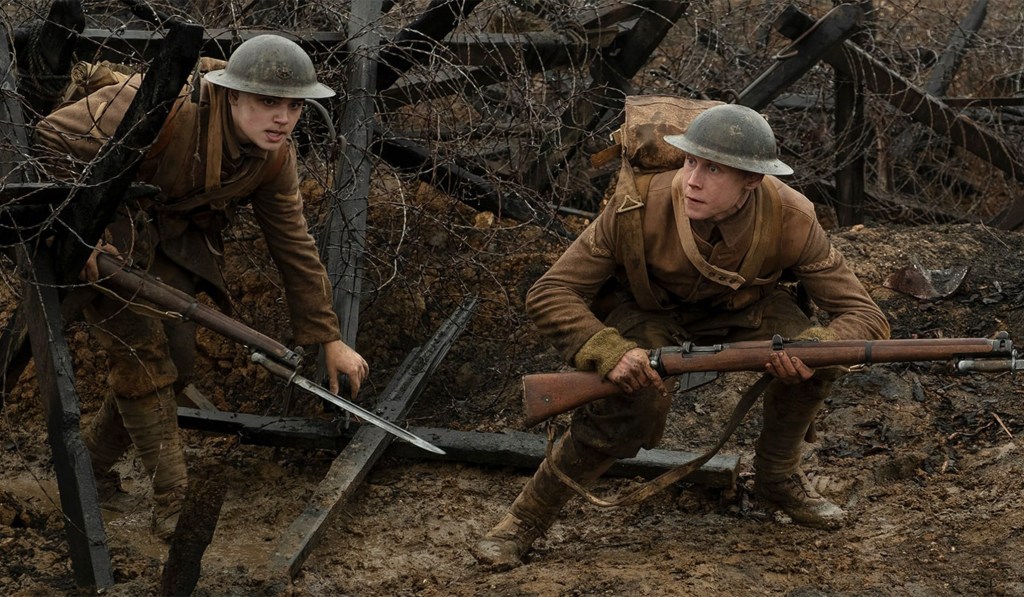
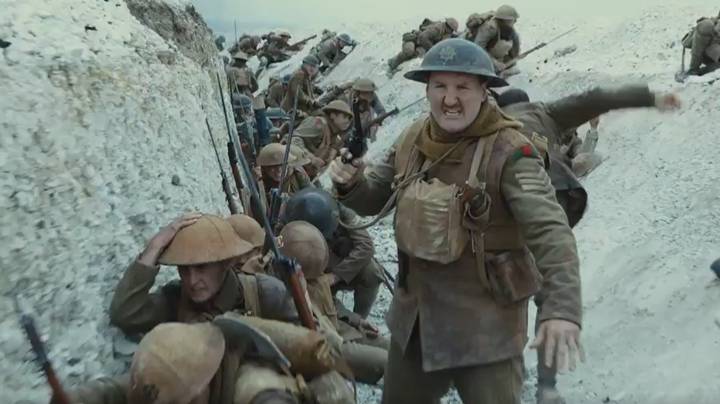
Written by Krysty Wilson-Cairns and Sam Mendes and directed by Mendes, “1917” is a World War One film that follows two young men tasked with an extraordinary order. Lance Corporals Blake (Dean-Charles Chapman) and Schofield (George MacKay) must travel across the German front line and warn the company of men there that they must call off their attack, as it’s actually a deadly trap devised by the Germans threatening the lives of those 1,600 men. As it so happens, one of the men chosen for this treacherous quest, Blake, has an older brother in the company of men that are set to attack the following morning. The perfect motivator to get an urgent message to the right people in time.

What makes this war film work so well is the direct and immersive nature of a simple tale of two soldiers delivering a pertinent message that holds the future of hundreds of lives in the balance. The intimate nature of following these two characters so closely on a mission fraught with danger around every corner is so damn exhilarating and it’s made all the more impressive with veteran cinematographer Roger Deakins behind the camera. The decision to shoot the film as if it was done all in one take was a smart choice that keeps you with these characters through every moment on their journey. We’re brought along with Blake and Schofield as they experience unspeakable horrors, small wonders, quiet beauty, and a surreal grief all driven by a powerful need to carry onward and complete their mission.

I definitely understand how the film has been nominated for so many awards, and in lesser years of Cinematic history- it may have swept the Oscars. It’s a treasure trove of wonders that we cinephiles find ourselves in when looking back at 2019 as a whole. I don’t want to dive too far into the details of this one, as it’s best experienced in the total blackness of a movie theater, but it was one of the more powerful movie-going experiences in recent memory for me. I am so incredibly conflicted with the awards categories, but hell, none of that really matters at the end of the day, we should all be so lucky to have had so many excellent films in one year.

If you, like me, didn’t catch this one right away- I highly suggest seeing it before it leaves the theaters. “1917” is an excellent, moving, and ethereal war film that perfectly captures the human element when concerned with the clashing of nations. This is one of the best war films, in my opinion, to have come out in the last thirty years. Its’ up there with “Saving Private Ryan”, it stands with cinema’s giants.

Final Score: 2 Lance Corporals

film

Review: Knives Out

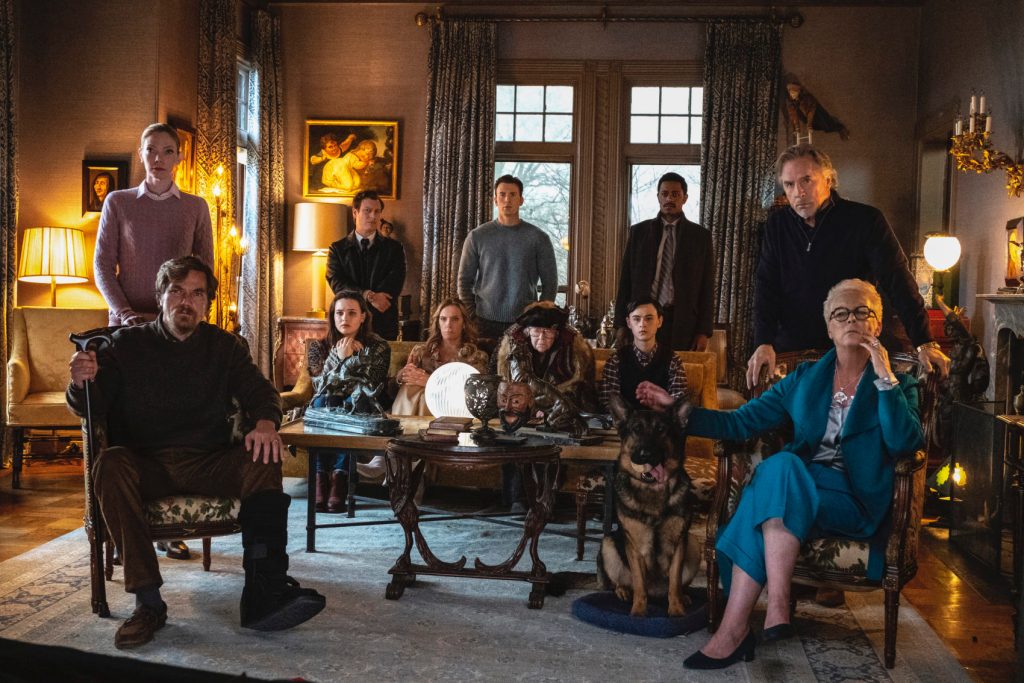
Written and directed by Rian Johnson, (Hey stop! Quit shouting and throwing things!) “Knives Out” is a murder mystery throwback to the Agatha Christie style of such stories. This is a film that is wholeheartedly enamored with the classic ‘Whodunnit?‘ It’s also very aware of it’s place and relation to the genre classics, though while the film revels in the usual machinations of a murder mystery- it doesn’t hold itself to those rules and is keen to take a different tact whenever given the opportunity. As with most stories within the genre, it begins with a dead body. Who just so happens to be Harlan Thrombey (Christopher Plummer) the incredibly successful mystery author who had just turned 85 the night of his death. Thus, the game is afoot. With the whole Thrombey family still in town due to the birthday celebrations, a mysteriously hired gentleman Detective named Benoit Blanc (Daniel Craig) digging around, and the quiet yet warm home nurse Marta (Ana de Armas) there to help pick up the pieces, there’s an awful lot of suspects and heck of a lotta suspicion in the air.

The Thrombey clan isn’t exactly one forged in humility or solidarity. First there’s Walt Thrombey (Michael Shannon), eldest son of the author who runs the publishing company that sells Harlan’s books. He’s been trying to convince his father to sell the books rights for film and television adaptions for years, and that night Harlan effectively fired his son from the publishing company. Next is Joni Thrombey (Toni Collette), former wife of one of Harlan’s sons who had passed on years ago and in that time she’s become a member of the Woo-Woo society, and instagram influencer of sorts. She’d been getting allowances from Harlan for her daughter Meg’s university (and also skimming a bit off the top to boot), though Harlan made it clear that he intended to cut her off that same day as well. Then there’s Ransom Drysdale (Chris Evans), the playboy and black-sheep of the family. He’d gotten into the biggest argument with Harlan that day out of anyone and stormed off early in the night when he learned that he was getting cut from the will. There’s a lot of combative energy and spiteful angst going to and from all of the Thrombeys as each and every one are interviewed by the inimitable gentleman sleuth himself, LeBlanc. There’s something incredibly exciting about an infamous Detective with a southern drawl questioning a bunch of rich entitled ne’er do wells in a massive country mansion that feels ripped from the Clue film. So much so that several characters feel the need to point these things out, and that’s part of the fun of this film- Rian Johnson’s contagious entusiasm practically bleeds off the screen.

There’s a whole bunch of twists and turns that the film’s mystery takes, and just when you think you’ve got it pinned down there will be another flashback from a different perspective or a return to certain events but with new information. “Knives Out” is an excellent film in a genre that has all but evaporated from cinema today, and we’re lucky to have such an entertaining resurgence with this film. The writing is playful and inventive and the characters are all a treat, but the cast of high caliber actors within this film is the reason to see this one. If you’re into a solid throwback to the classic ‘Whodunnit?‘ structure of a murder mystery- give this one a shot!

Final Score: 1 Chris Evans in a White-Knit Sweater

film

Review: Parasite

*Warning! In order to discuss this film, I will be spoiling large aspects of the plot- I highly recommend this one though!*

Written by Han Jin-won and Bong Joon-ho, and directed by Bong Joon-ho, “Parasite” is a social satire that greatly benefits from the audience knowing as little as possible for your first viewing. Being the first film from South Korea to be nominated for Best Picture at the Oscars this year, it seemed like a perfectly good reason to check this one out. That, and the fact that Bong Joon-ho is an excellent director. Personally, I’ve only seen a few of his films, namely “Snowpiercer” and “The Host”, both of which were quite enjoyable and fun genre films that housed aspects of a critical eye towards society. This film, however, is far more critical of society and it’s financial machinations. If you want nothing more than my recommendation to see this film, then you have it already. It’s easily one of the best films of the year, and as already mentioned, the less you know, the better… I suspect. “Parasite” focuses on two families, the Kims, and the Parks. The Kims are in dire financial straits, a family of four adults living in a small, cramped, and sunken, apartment. They fold cardboard pizza boxes for income and allow street fumagation to freely blow through their windows- free fumagation is better than none, and besides, it will get rid of their bug problem. Eventually Ki-woo (Woo-sik Choi), the son of the family, is offered a lucrative job by a close friend as an English tutor for the daughter of a rich family in town. Ki-woo’s friend is heading out of the country for awhile and he doesn’t want just anybody mentoring this girl, none of his collegiate peers were up to the task though, as they might simply fawn over the young girl instead of actually teaching her. After his interview is a success Ki-woo begins to analyze the Park family’s situation and assess how he may fit his other family members into the high life as well. It isn’t long before the Kim family brutally excises the other working class people that earn their livings from the Park family and replace them with a member of the Kim family, extravagantly performing an act, or scheme, to fool the Parks into accepting them into their realm with high dollar luxury positions such as Art Therapist or Handmaid.

A lot of the film tells its story purely through the visuals displayed onscreen. Through the staging and direction, we can see how differently the two families operate and how each family’s financial status orients their needs for certain skillsets. The two families are staged in near complete opposites, the Kims are almost always physically close together onscreen and working efficiently as a group. The Parks on the other hand are barely in any shots with other members of their family, and when they are there are large empty spaces inbetween them. This division extends to a multitude of layers that separate the two families. The Parks can afford to outsource skills that the Kims couldn’t live without, cooking, cleaning, understanding the needs and idosyncracies of their closest family members etc. The film even wisely showcases how even simple things can affect the families in wildly different ways. When a rainstorm ruins the Park’s camping trip and they have to come home early, they complain that it was “a disaster”. However, when the Kims return to their home at the bottom of the city, the rain that the Parks so quaintly admire in the night sky, has actually caused the Kims a real disaster in flooding their home. “Parasite” even goes so far as to show that while the Parks are very particular about their maids, housekeepers, and drivers “crossing the line” between work and their family life- they have no qualms about reaching out to the Kims while they’re off duty to request a litany of demands.

The writing and complexity of this film are at the core of why it works on so many levels. Literally involving levels to be exact. There’s a lot to be said of the imagery involving staircases throughout the film too. The Parks ascend stairways while the Kims descend, fearing a misstep into the abyss below. Keep an eye out for stairs, they’re all over the film, who goes up them, and who falls down them. I think one particualrly small aspect that could get overlooked, is actually one aspect that I respect the hell out of, creatively speaking. Bong Joon-ho has an opinion about the world and what it does to people, but he doesn’t lay any judgement on the characters. Neither the Parks or the Kims are full-fledged stereotypes, the film doesn’t even seem to embrace each family’s perception of the other. The Parks are not villains or naive, nor are the Kims triumphant protagonists or simple helpers. There are societal criticisms to be had for sure, but these events unfold plainly before us, without a wagging finger or an opinionated slant with a heavy-handed message. If you haven’t seen the message of the film yet, it seems, to me at least, to be about capitalism and how it can turn anyone into Parasites. The film cleverly makes an argument for how daily competition can get cutthroat, but more importantly it dives into how the poor can get lost in the chaos by trying to smother each other in an attempt to climb into the higher class. One of the most powerful scenes in the film is also its most depressing. I’ll leave the specifics to the third act, but when Ki-woo allows himself to be filled with hope at the thought of eventually saving his Father from isolation through the power of money.. it is this hope that has infected him, it is what continues the cycle of poverty and despair. Ki-Woo even has a plan. Which is even worse when considering what his father pointed out earlier in the film when revealing that lives with laid out plans are never lived that way.

I’d be a fool not to point out the crucial performances of all the actors in the film, the movie wouldn’t work without the skills on display and comittment to the craft. Kang-ho Song, as Ki-taek (the father of the Kim family), in particular was a fascinating performance to watch evolve over the course of the film, he did so much with even the smallest facial expressions. Everyone though put in standout performances. “Parasite” is a unique and powerful drama/thriller that I highly recommend to everyone. This movie should win Best Picture, it’s got my vote! (If I were voting for the Oscars that is…)

Final Score: 4 Parks, 4 Kims

*For fun, check out this video that further analyzes the film, be warned though, it contains ALL THE SPOILERS!

film

Old School Review: “They Live” (1988)

Written and directed by John Carpenter, “They Live” is genre filmmaking at it’s finest. Overtly political and eerily prescient with it’s themes and imagery, this film from Carpenter is one that could (or should) be remade or rebooted (or however you want to phrase it) with today’s issues and politics. Famous Wrestling star “Rowdy” Roddy Piper plays as the lead here, John Nada, a wandering vagrant looking for work. As Nada enters Los Angeles, he’s optimistic about his opportunities despite his standing in life. Eventually he’s hired as a construction worker and one of his fellow homeless workers, Frank (Keith David), offers to show him where he and others in similar situations live, a small community of ramshackle housing just outside of downtown L.A. After he’s accepted by the multiracial and marginalized people, Nada begins to notice a few strange things taking place.

In the homeless community there’s a couple television sets strewn about with a few people aimlessly watching them. Though when alternative programming begins to break through the static, a man’s face appears as he tries to bring the truth to the people. He warns of the ruling class who own us, using humanity as cattle, and taking advantage of our fondness for wealth for the loss of the human race. No, these aren’t Wall Street Executives, Politicians, or Industrial Tycoons- they’re an alien race hiding amongst us and using these positions of power to subjugate the masses. The allegory isn’t subtle, but it sure is a fun concept, and Carpenter squeezes every drop of vile ichor of defiance against his real world targets as he can. Not long after the revolutionary programming is cut from the air, Nada witnesses one of the homeless men hurrying off to a church just on the outskirts of the shantytown. Piquing Nada’s interest, he decides to go check it out. As he enters into the back of the church, he sees cardboard boxes all over the place alongside a chemical lab of some sort. After he accidentally trips into a breakaway wall, he quickly puts the fake wall back into place and heads back to the shantytown. Things rapidly escalate out of control after this with helicopters hovering over the revolutionaries’ church hideout before they get paranoid and escape just before an army of police and SWAT teams descend upon the church. When they don’t find their victims, they turn to the homeless shantytown and swiftly destroy it with brutality and efficiency. The next morning after the demolition, Nada heads back to the church and stumbles across the one cardboard box left inside the fake wall he’d fallen into before. Inside are a bunch of black sunglasses, curiously, he takes the box and heads into downtown L.A. before tying on a pair. The result is a profound awakening for Nada as the sunglasses allow him to see the true meanings of all the advertisements throughout the city in black and white.

As he wanders about the city in sheer awe, he also realizes that the glasses allow him to see which people are disgusting aliens in hiding, and which are simply humans. Notably, most of the upper class and people in positions of privilege are alien impostors enjoying the finer things in life. After he reveals to a few aliens that he can see them, they immediately (and creepily) all turn towards him from across crowds and stores and speak into their watches describing Nada’s appearance and reporting it like a hivemind collective. “We’ve got one that can see“. So after causing a bunch of raucous and gaining a whole lot of attention for himself, Nada takes up arms and openly starts killing any impostor aliens that he can find. After this backfires when he finds a human he (wrongly) thinks he can trust, Holly (Meg Foster) one of the TV executive personalities in L.A., Nada searches for Frank. Which brings me to one of the silliest yet most memorable fight scenes in film to this day. Frank wants nothing to do with the danger and notoriety that Nada’s earned, but Nada desperately wants to convince the only person that’s been a friend to him in the city to see the truth and neither will back down. Thus resulting in a six minute long fight scene in a Los Angeles alley, every time you think it’s over, it just keeps going. Apparently, Roddy Piper and Keith David choreographed the whole fight themselves and mostly fought it out as you saw it onscreen, with the exception of those groin shots and the obvious work that goes into fight scenes in films to avoid actual harm. Finally, when Nada forces the glasses onto Frank’s face and he sees the truth, he is shocked and energized to fight against the system with Nada. The third act gets silly with it’s level of over the top violence and Nada’s one-liners are typical of many 1980’s action stars, but it’s all in good fun. Eventually the two escape using the aliens teleportation to find a hidden bunker of self congratulating aliens and the humans that got rich off of the cooperation and further enslavement of humanity. It’s another on-the-nose commentary about those who help to enable the rich and elite to control the majority of people, and I enjoyed the anti-establishment tone and messaging Carpenter was going for throughout the film.

As the two work their way through the compound, they discover that the aliens are using a broadcasting signal that emits waves that mask their appearance to the masses. So, obviously, they head towards the tower on top of the building to destroy it. On the way there they’re met by one of the men at the homeless encampment who was actually a human mole in the shantytown who congratulates them for being accepted into the big leagues and shows them around. Eventually the two out themselves and make a last ditch effort to scale the skyscraper’s stairwells to the roof. Once there, Holly tries to stop Nada, but he declines and destroys the broadcasting device and is unceremoniously gunned down, but not before he gives the aliens one last middle finger. As the signal fades, the aliens begin to appear in their true forms across the globe and the disgust on the humans’ faces everywhere reveal an optimistic note to end on.

“They Live” is ripe with potential for a sequel in today’s world. If the Reaganomics of the 1980’s had enough potential for cinematic mockery and criticism than the Trump era is perfect for a sequel of this kind. All of the social commentary that made “They Live” work so well could be applied here tenfold. Income inequality has skyrocketed since the 1980’s, Trump himself is the epitome of a stooge impostor that enforces policies and executive orders that pit the middle class against each other based on race and hatred, I mean, the material for this basically writes itself. Just toss John Cena in for the Nada archetype of Middle-America everyman and team him up with Lakeith Stanfield or Daniel Kaluuya and have them end up taking on the elite alien overlords and call it “We Sleep”. You could do so much with this concept in today’s world, just think of the examination of social media and smartphones as tools of the subjugation of the masses- I mean, this needs to happen.

Final Score: Six Minutes of Street Fighting

*A quick note: I don’t usually get too political in my reviews or analysis of films- but as this film is uniquely political in nature, I felt that it was vital to the discussion. Please be kind and courteous if you leave comments, lets have a civil discourse if we must disagree. Hell, disagreeing about politics is about the most American thing you can do, let’s just not turn to name calling or personal attacks- it’s just a movie after all. Thanks for reading!