Written by Shinobu Hashimoto and directed by Kihachi Okamoto, “The Sword of Doom” is an existential samurai film that dwells on a titular character that isn’t exactly altruistic, to say the least. This is, essentially, the story of a villain. A Samurai with a unique style, long lost from any traces of morality, Ryunosuke (Tatsuya Nakadai) spends the majority of the film brooding and sulking about until he bursts with a flurry of violence. Don’t fret, this film most assuredly lives up to its pulpy title. Ryunosuke appears suddenly in the opening scene when he happens upon an old man praying for death so that his granddaughter would not be burdened by his increasing fragility. He swiftly grants his elder’s wish and moves along nonchalantly. Our protagonist is almost more of a singular force set upon the world than a human character, a skilled swordsman with a thirst for violence.
Early on in the film Ryunosuke’s father, who disproves of the psychopathic Samurai’s technique, pleads with his son to purposefully lose an upcoming fencing match. His opponent’s wife, Hama (Michiyo Aratama) also urges him to concede and throw the match against Bunnojo Utsuki (Ichirô Nakatani). Ryunosuke agrees on one condition, that Hama sleep with him before the match. Hama agrees, though Bunnojo discovers the infidelity before the match’s start and has made the clash a far more personal affair. After the fight is considered a draw Bunnojo lunges for a kill shot, but Ryunosuke’s entire style leans into this tactic, lying in wait for his opponent to strike with his eyes and sword leisurely cast aside. After Bunnojo is slain Ryunosuke and Hama are run out of town and the film cuts to an unspecified jump in time.

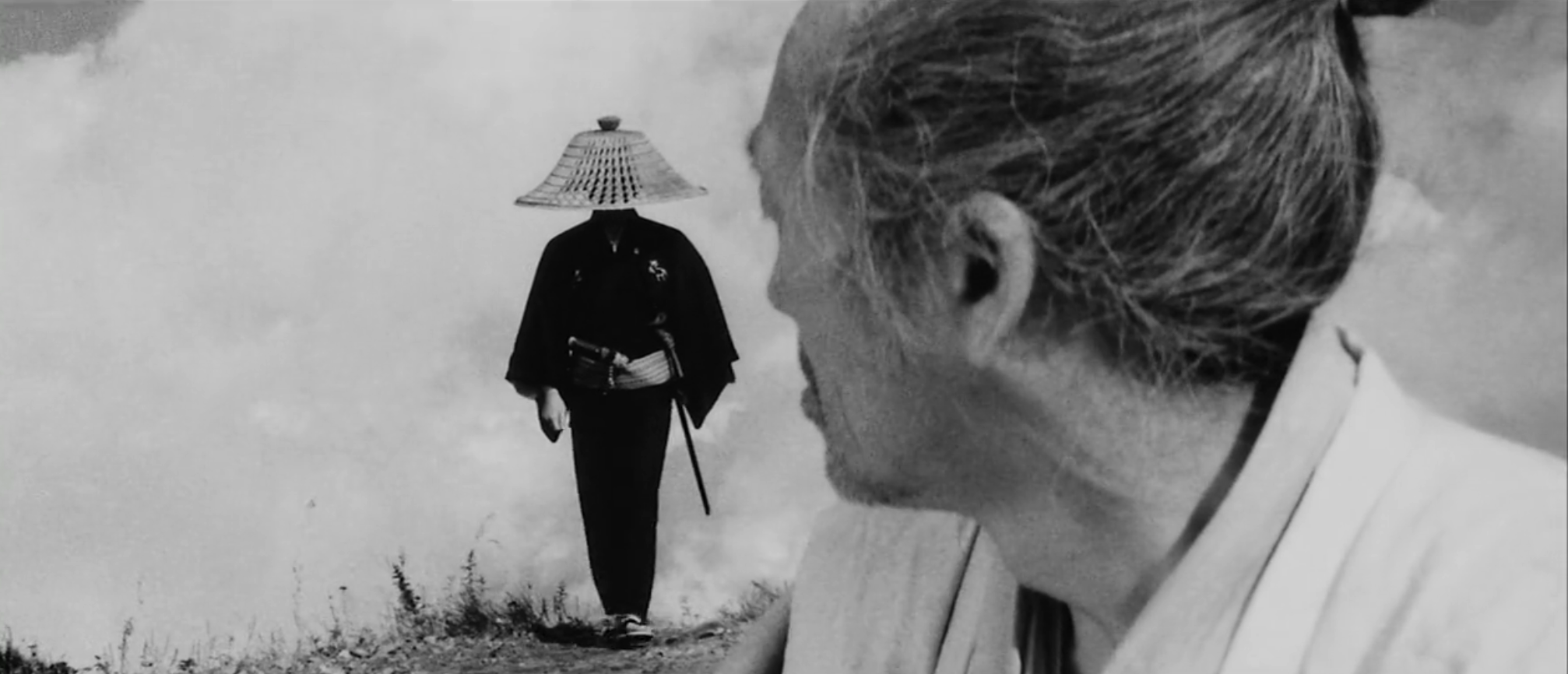
A few years later, roughly, Hama and Ryunosuke are married and considering returning to their village. Ryunosuke’s a sake drunk and Hama is resentful of her husband and her situation in life. Ryunosuke hears of rumors that Bunnojo’s brother Hyoma (Yûzô Kayama) is seeking vengeance, so he does a bit of research. What he doesn’t know is that his father urged Hyoma to train under master fencer Shimada (Toshirô Mifune), to wipe the shame of Ryunosuke’s actions from his family’s name. I won’t go into an excessive amount of detail on every plot point, but that is the skeletal framework essential to understanding the film. “The Sword of Doom” harbors a dense and nightmarish atmosphere that is used to great effect. The cinematography and blocking of the actors is magnificient and alleviates any stress that the admittedly convulted plot contributes to. The remainder of the film has some of the best Samurai action I’ve seen in films (so far), and Ryunosuke’s descent into existential paranoia is an excellent departure from his stoic confidence earlier in the film. Though my favorite scene of the whole film is when Ryunosuke witnesses Shimada’s expertise in killing an onslaught of attackers on a wintry night- his skill is enough to shake the soul of the morally corrupt Samurai. Aside from the Kurosawa films in which these two actors frequently come to blows, “The Sword of Doom” takes a different route, the two iconic Samurai actors never cross blades. Though Ryunosuke is profoundly affected by seeing the superior’s swordsman’s technique in action.

This was the final Criterion Collection film that I picked up through a sale they had recently, and it was worth every penny. The Criterion Collection does an excellent job with their film restoration. They clean up the audio and frames of film of any static or dirt and allow the full vision of the original filmmakers to shine through. Criterion commits to a commendable standard of quality that I personally highly value and I cannot recommend them enough. If you’re in need of a good Samurai film and have exhausted the library of Kurosawa, then this is a fine film to sate your katana brandishing needs.
Final Score: Scores of fallen foe


 spacecortezwrites