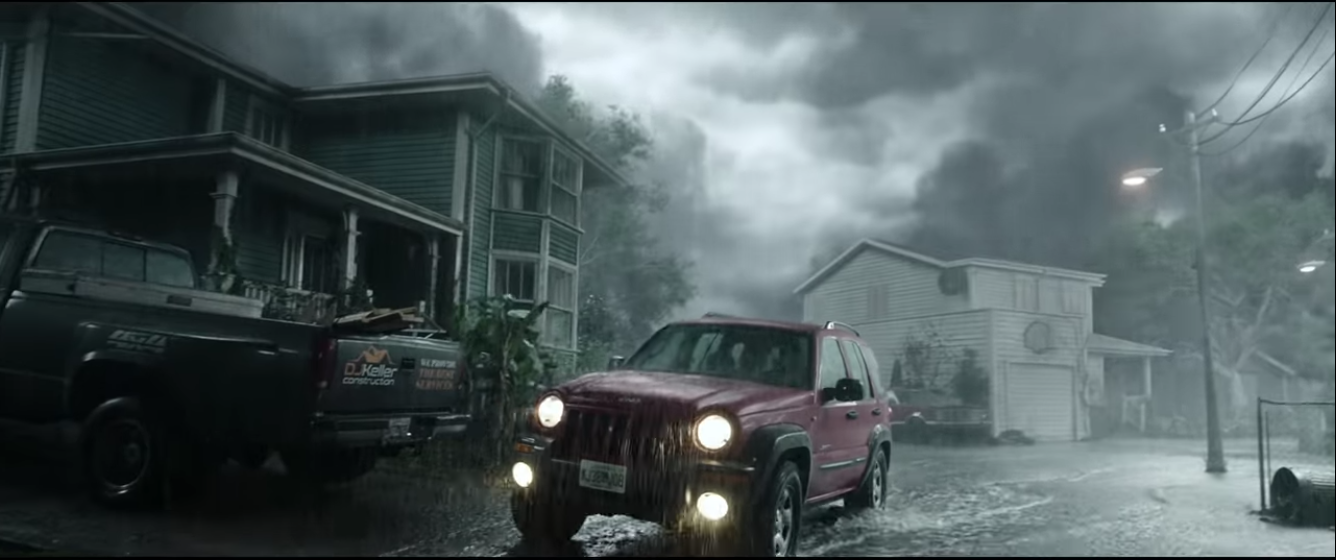
Written by Michael and Shawn Rasmussen and directed by Alexandre Aja, “Crawl” is a tight thriller about a young woman helping her estranged father survive a hurricane while fighting off numerous alligators. The heavy marketing of Sam Raimi as a producer may have caught my attention, but it was the prospect of a competent summer horror film that got me into a seat for this one. That, and the fact that I tend to gravitate towards a good “man versus nature” story. The thing that struck me most in the first act of the film was that the film took itself seriously as a competent thriller. Which was more than I expected going into this one, I assumed it would be more tongue-in-cheek camp, something along the lines of the director’s previous work in “Piranha 3D”. We begin the film with our lead character Haley (Kaya Scodelario) in a swimming practice as a Hurricane begins to batter the Florida coast. The film wastes no time getting the plot moving along as Haley’s soon called by her sister Beth (Morfydd Clark) to see about their father Dave (Barry Pepper), Haley agrees even though we see apprehension in her eyes.
After finding an abandoned apartment, Haley heads to the old family home (recently put on the market)
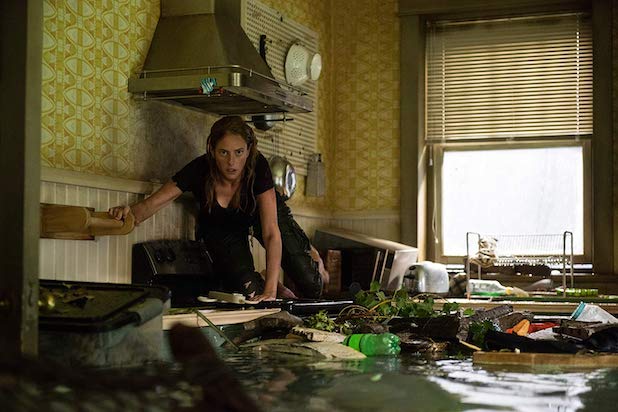
Haley gets to the family house and searches for her father, eventually leading to the crawlspace under the main level. The whole first act resides here, and that was a smart decision. After finding her father unconscious near some piping, she comes face to face with a large ‘gator’- the one that took a nasty bite out of her father’s leg. Haley manages to wake her father back up as they try to find a way around the ‘gator’ that’s perched itself right next to the stairs out. I won’t go through and breakdown every character action in the film but the filmmakers and cast did an excellent job of playing into natural fears that people have, claustrophobia, aquaphobia, mysophobia etc. The cat and mouse sequences between Haley and the ‘gators’ were very effective and pleasantly thrilling throughout! Those swimming practices paid off. The constantly rising water was also very effective in forcing the characters to push themselves and go for the riskier maneuvers.
Rising water works great as a ticking clock!
Keeping with the rising water, this forces the characters to move into the next floor or room, all of which come with new challenges and scares as the gators have new advantages and difficulties as well. There are a few qualms I should mention at this point- but they are few and didn’t truly impact my enjoyment of the film. Any and all side characters that are introduced in the movie are essentially only there to be killed by alligators- which is fine, there needs to be a legitimate threat introduced to instill urgency, but I was surprised with the speed at which these people were devoured by these modern day dinosaurs. There’s also almost no thought put into how our two main characters would realistically handle some of the admittedly gruesome wounds they have inflicted on them throughout the movie- like, you can’t push a major leg bone back into your leg and then walk and run on it just fine when needed- but hey, this is an hour and a half movie about killer alligators, it’s not “Citizen Kane” you know?
Barry Pepper stars in CRAWL from Paramount Pictures. Photo Credit: Sergej Radović.
So, if you’re looking for a fun summer flick with some good scares and solid pacing under a tight hour and thirty minutes- this is it! “Crawl” was better than expected and a damn fine summer flick to kill a hot afternoon, check it out!
Final Score: 1 Father, 1 Daughter, and Dozens of Alligators!
Written by Matsutarô Kawaguchi, Akinari Ueda, and Yoshikata Yoda, and directed by Kenji Mizoguchi “Ugetsu” is a film that hides its true intentions behind the veil of a ghost story. The supernatural aspects of the film cleverly disguise the introspective look at the different sexes and how war frenetically warps both. Frankly, the idea of ghosts here aren’t what modern audiences may expect, it is an older representation of the dead that take issue with moving on from this world. There are no jumpscares here, but there is a moral tale that should cause concern and, dare I say it, a deeper level of fright than your typical horror show. We are set in sixteenth century Japan during a civil war in which two lower class families are torn apart just as much by the greed and avarice that foments during wartime, as their own miscommunications.
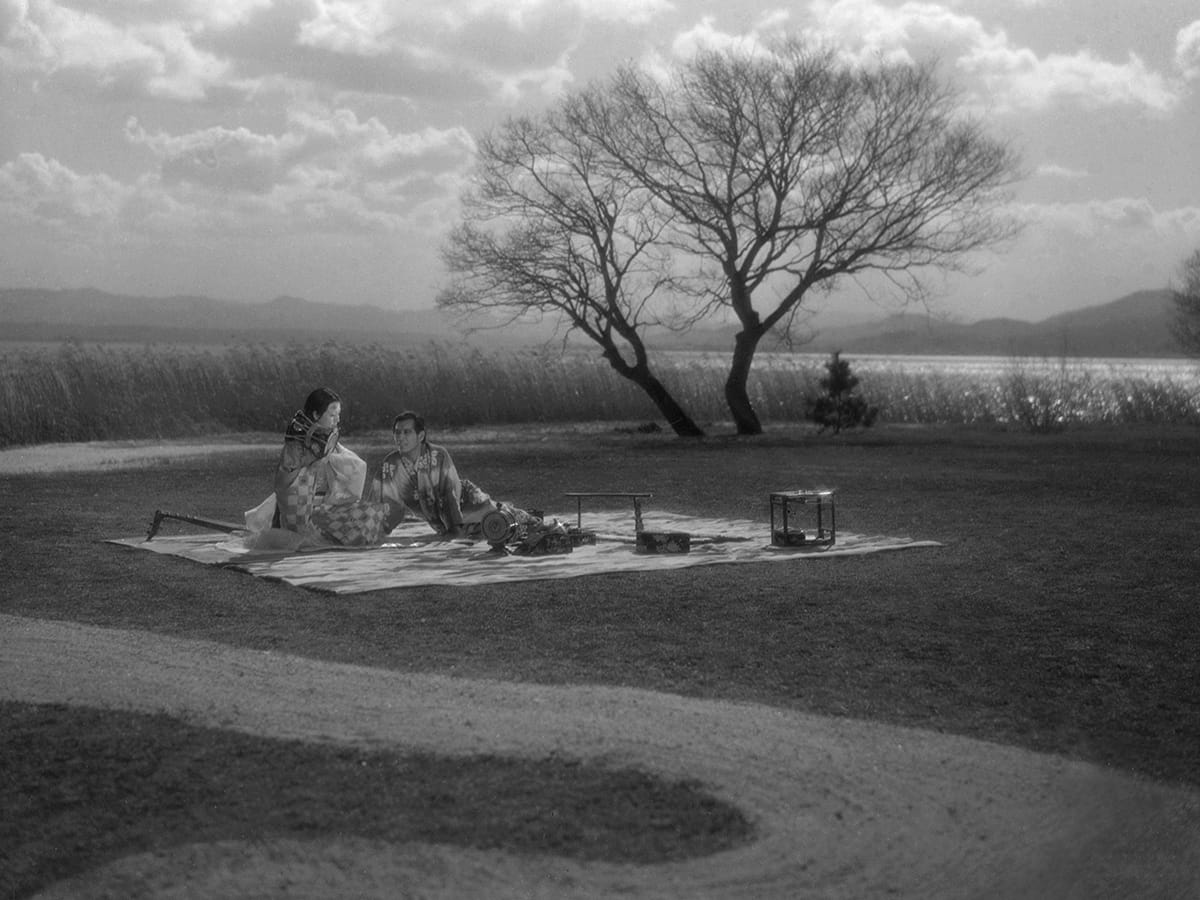
Mizoguchi’s camera is almost always flowing in poetic fashion, mastering the long take and transitions that emit an ethereal tone.
Genjurô (Masayuki Mori) and Tôbei (Eitarô Ozawa) are the men of two small households in a rural village near the shores of Lake Biwa in Ōmi Province. Genjurô, a potter, and Tôbei, an ambitious fool with dreams of becoming a Samurai, head to a larger village nearby that’s heard to be having a small economic boom due to the encroaching war. Despite the concerns of their wives, Miyagi (Kinuyo Tanaka) Genjuro’s wife, and Ohama (Mitsuko Mito) Tobei’s wife, the two men hurry off to earn money, material value, and in their eyes; the satisfaction of their wives despite their own fears of inferiority. Which is nonsense to begin with as both of their wives tell them that they are enough for them as they are. Despite the worries of their wives and the village elder, the two men come back successful with a small batch of earned income, which only bolsters their egos to earn more silver and gold the next time they embark.
This scene was excellently shot and eerily immersive.
As Genjurô and Tôbei rush to prepare their next batch of pottery in their kiln, the approaching war marches upon their doorstep before they can properly assess their work and are forced to leave while it burns, unattended. The two men begrudgingly trot off with their families as soldiers arrive in their village, but it isn’t long before they are so consumed by the idea that they might lose all of their effort that they run off to check the kiln. To their surprise, the pottery was completed without harm and they quickly gathered their product and convinced their wives to travel with them to the city to sell their goods once more. They choose to take a boat across the lake, avoiding the foot-soldiers of war. However once on the water, and the fog rolls in, we are at once transported from a wartime historical drama to one of supernatural happenings. An unspoken sense of dread spreads as another boat emerges from the mist with a dying man to warn them of pirates out among the waves. After which they decide that sneaking about the edge of the water might be safer. Genjurô’s wife and boy head back towards safety, but Ohama fears that Tôbei’s dreams of becoming a Samurai could overtake him, so she departs with them to hurry along the selling process.
A newly decorated Tôbei discovers Ohama working as a prostitute.
As expected, Tôbei runs off after spotting a decorated warrior in the crowd. Ohama chases after him to no avail while Genjurô remains to sell their wares. Not long after Ohama’s rush to find Tôbei, Genjurô is approached by Lady Wakasa (Machiko Kyô) and her aide. They point out a few dishes and a sake set and tell him to bring them to the Kutsuki mansion just outside of town. Now, here’s where each of the four major characters have major scenes surrounding their decisions and failures. Tôbei eventually finds a suit of armor and sneaks about to the battlefield where he stumbles upon a dying general of the opposing faction who asks his accompanying lieutenant to execute him by decapitation. The loyal underling abides, wipes tears from his face, and takes the head of his fallen master right as Tôbei attacks from behind, killing the lieutenant and hurrying away with the stolen head as his prize. He finds the nearest barracks, presents the head of an enemy general and is rewarded fondly with a fitting rank, horse, and a small regimen of soldiers to command. Ohama’s luck is not so kind, as she’s captured by random footsoldiers, raped, and thrown to the street. She eventually finds work as a prostitute and runs into Tôbei with his men at an inn. They argue at length in a scene where I personally thought Ohama might actually kill Tôbei, but eventually they abate and both discard their new personas and return to the village having learned that unchecked ambitions can have great costs.
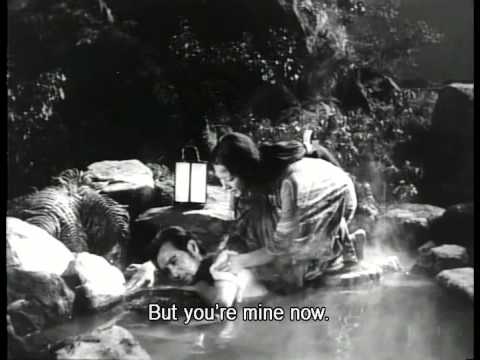
Lady Wakasa’s seductive illusions further illustrate how war inflicts suffering on men and women alike- even carrying some trauma to the afterlife.
Genjurô and Miyagi, however, fare worse fates than that of their neighbors. Given that Mizoguchi’s main narrative focus is the suffering of women due to the ambitions of the men in their lives during times of heightened conflict, the overarching narrative between Miyagi and Genjurô is particularly grim. While Genjurô heads to the Kutsuki manor with Lady Wakasa’s order, Miyagi and their son Genichi are attacked on the road home by rootless foot soldiers. In a moving sequence Miyagi is hassled for the food she’s carrying, Genichi strapped to her back, but the men quickly overcome her and stab her to death with their spears and trot off with their spoils to devour them in the background- all while Genichi wails in the foreground clasped to his dead mother’s back. This macabre scene paired with the dream-like pleasures Lady Wakasa offers to Genjurô may cause a battle of emotional turmoil in the gut- and as this film’s historical setting is used as a reflective mirror to Japan’s postwar sensibilities, it’s introspective look at Japan’s wartime morality is powerful and poignant. Eventually Genjurô is confronted by the reality that his new illustrious lover may not be all that she seems, a local shopkeeper turns pale at the mention of Kutsuki Manor and a wandering priest notices that Genjurô has been in contact with supernatural forces and applies exorcistic tattoos all over his body. When he wakes from his illusory nightmare and sees that the Kutsuki manor has been in ruins for years, Genjurô returns home sober and in need of his family. Waiting for him there are Genichi and Miyagi, with food and a bed roll waiting. It isn’t until the morning after that Genjurô realizes that his wife’s ghost was watching over their son, and he goes back to solemnly fire up his kiln, and help Tôbei tend his fields.
Miyagi’s final moments…
In retrospect, I did enjoy this film. Mizoguchi has a unique direction, and his narrative focus is one that is often underrepresented- especially in his own time. While this film did not capture me or necessarily take my breath away, it was a good film that I respected. This was the first film of Mizoguchi’s that I have seen, and I’ll definitely be returning to his library of films in the future. I recommend this one to anyone interested in the film’s sociopolitical message or simply to see another Japanese master of cinema. I recommend giving the links listed below a look if you want to know more about the film and the creators involved with it.
Final Score: One Potter, One Samurai, and One Ghost
The article below is what drew me to check out Mizoguchi in the first place. Having recently seen a lot of Kurosawa and Ozu films- I found this article’s title to be both provocative and mystifying. Thus credit, where credit is due:
*Warning! Due to the nature of the film, this review will contain spoilers: you have been warned*
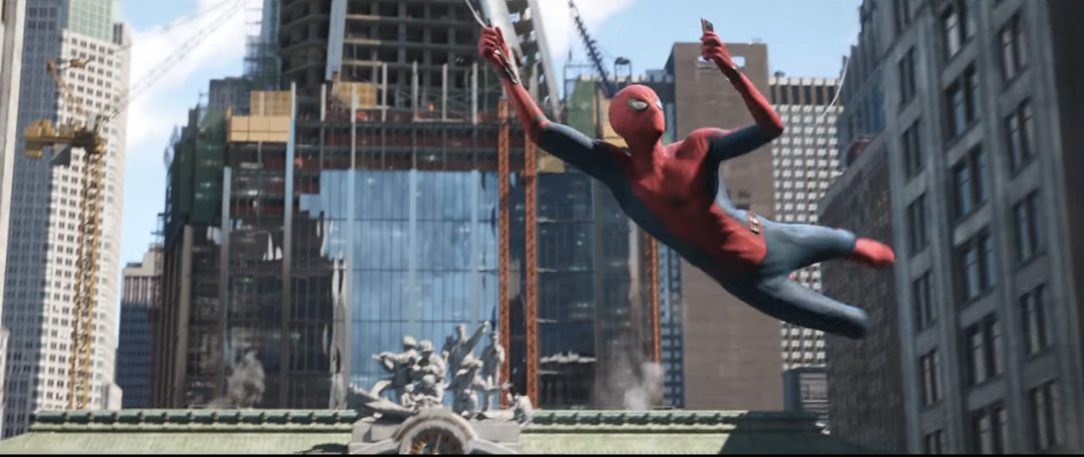
Written by Chris McKenna and Erik Sommers, and directed by Jon Watts, “Spider-Man: far from home” is the second iteration of Tom Holland’s Spider-Man within the Marvel Cinematic Universe and the first film to follow up the two part culmination of Marvel’s Infinity Saga. As such the film had to juggle several major obstacles. In-between dovetailing the final film of phase three including the world’s reaction to the death of Tony Stark and retirement of Captain America, and expanding on the social dramas of Parker’s high school friends, AND giving us a satisfying and comics-accurate version of the fan favorite villain Mysterio- this film had many a hurdle to leap. Masterfully, all this and more is accomplished with style, wit, and heart.
So, the film hits the ground running with Nick Fury and Maria Hill investigating a natural disaster in Mexico with more than a few hints of curiosity surrounding it. As soon as a giant monster forms from the rubble around them, another new factor emerges- the mysterious Quentin Beck garbed in a cape with a cloudy fish bowl atop his head. Later in Europe we discover that this unheard of hero is working with the remnants of S.H.I.E.L.D. to stop these Elementals from destroying the Earth- just as they had done on his own Earth from another parallel universe… or so he tells us. Okay, here’s where anyone who knows anything about the character of Quentin Beck knows that he’s lying. That is, IF, Marvel Studios kept in line with the traditional aspects of the villain Mysterio. Which to my delight- they absolutely did. Jake Gyllenhaal’s performance in this film as Beck was pitch perfect for the character and his backstory of disgruntled Stark Tech creative slid wonderfully into the background of the MCU as if he had been there all along. Mysterio’s illusions throughout the film were excellently rendered, but there’s one scene in particular where the film blurs the line between mediums of film and comic-book in what I like to call, The Nightmare Sequence, in which Beck thrusts Spidey into illusion after illusion after which he gets so shook up he starts to question reality. Over all, this was an excellent example of a fantastic villain used correctly, while being comic-book accurate, and molded to fit this medium and existing story structure.
As for our hero, Peter Parker may not have been in his traditional setting, but this was a story well in line with the familiar tropes of our favorite webslinger. Throughout the film Peter is under constant pressure, from Nick Fury, from his potential rival for MJ’s affection, from Beck, but primarily, and poignantly, from the expectations laid upon him after the death of Tony Stark. Stark wasn’t just Iron Man to Peter, he quickly formed into the parental figure where other films utilized the reliable but familiar role Uncle Ben played in Peter’s life. He may not have said that singular advice that so motivated Peter in various other stories and mediums, but the advice that the tin man did give Peter was essentially similar, and from a place of personal experience for our late armored Avenger. Pull all of those story strings with the right amount of tension and you put Spider-Man where is meant to be in most of his stories, his greatest growth always comes from his moments of greatest peril. This film has that crucial aspect for the character, and the film crew behind these two Spider-Man films have utilized that well.
I wanted to quickly highlight a few of the things that I thought elevated this film a little further than it might have otherwise been without them. Zendaya’s MJ had a lot more to do this time around and her character was expanded upon in a thoughtful and charming manner. Ned (Jacob Batalon) and his girlfriend for the summer Betty Brant (Angourie Rice) were a fun aspect of the trip and reminiscent of how fleeting teenage romances can be. Fortunately though, they never crossed over into the void of being overly cringey. The few scenes and jokes we got with Flash Thompson (Tony Revolori) were entertaining and there’s even a quick moment where we get a peek into Flash’s personal life (it is very fleeting, but still appreciated). Oh, and how could we forget Happy Hogan? It must have been pretty amazing to be Jon Favreau on the set of this film, still keeping watchful eye on the film series he helped to craft into existence more than a decade ago now. I’m glad his character still has purpose and still matters in this cinematic universe, we should be so lucky to have him around! I can’t think of much else to add at this point, I highly enjoyed this film at the theater, and I’m very much looking forward to the next Spider-Man film starring Tom Holland and company!
Final Score: Hundreds of killer drones!
*Oh, and for the love of god: Stay through the credits for the best reveal in Marvel Cinematic history.
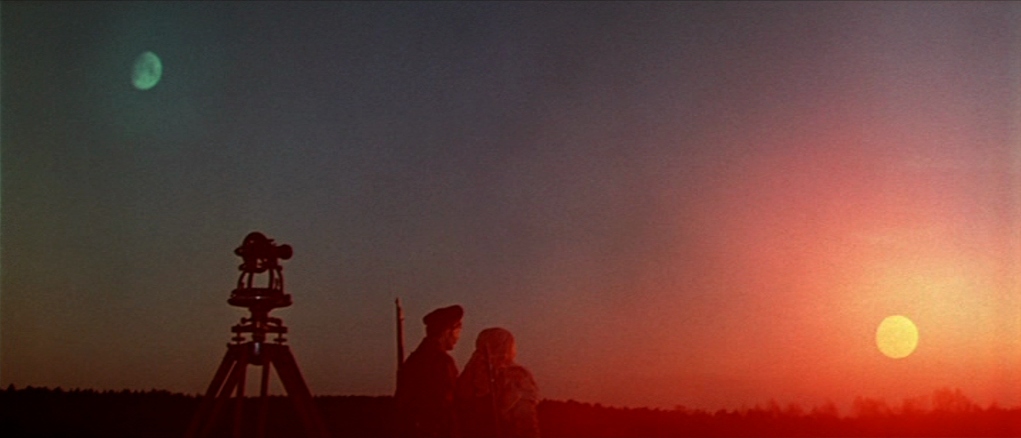
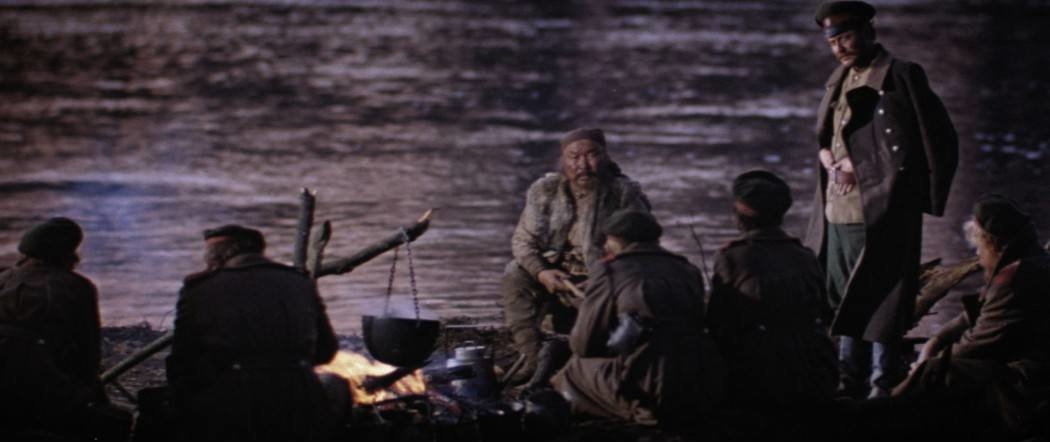
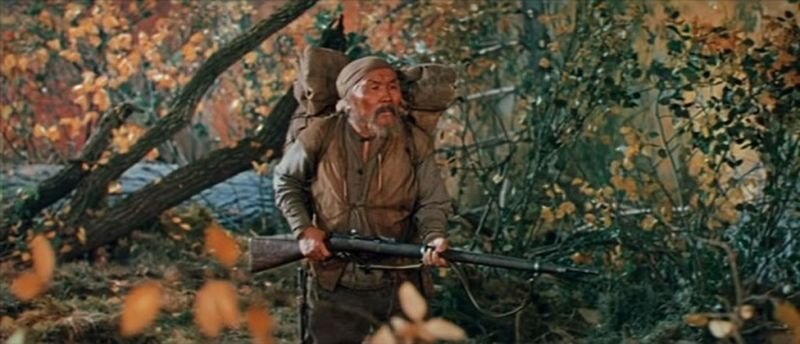
Written by Yuriy Nagibin and Akira Kurosawa, and directed by Kurosawa, “Dersu Uzala” is an adaption of the Russian explorer Vladimir Arsenyev’s memoir from his military explorations of the Ussuri basin of the Taiga in the early twentieth century in which he meets and befriends Dersu Uzala, a native hunter of the Taiga. This film won the 1976 Oscar for Best Foreign Language film and a litany of other awards across international film festivals and awards ceremonies, and it’s easy to see why. While the film may not immediately strike you as an one from the master Akira Kurosawa, either from the Russian language used or the fact that the film was shot on 70mm (the first and only time Kurosawa would do so), it becomes apparent that an auteur is behind the camera when viewing the melodic composure of the cinematography or the impeccable blocking of actors through the wilderness. The story is stylized as an epic, but intimately told through the two main characters of Captain Arsenyev (Yuriy Solomin) and Dersu Uzala (Maksim Munzuk). The film begins with the Captain and his crew traipsing through the Taiga until they find a suitable place to camp for the night wherein Dersu Uzala stumbles upon the campsite with the Russian exploratory group accepting him and offering Dersu the position of being their guide.
The elder hunter accepts this role and stays with the group for months, doling out tidbits of wisdom gleamed from a life spent in the wilderness. He often puts a point to the soldiers not to waste materials and resources, to respect nature and those wandering through it, and to make the Taiga better off than when you entered it. As the winter months press on, the Captain thins the group and sends most of his men off to different stations and bases. At one point he and Dersu alone head out to a frozen lake to graph any notable points of interest for their topographical survey. Eventually, after wandering far enough into the barren and frigid wastes, the wind picks up into a heavy gust, and despite all of Dersu’s expertise- he loses their tracks as they’re swept away in the blustery conditions. Which leads to easily the most frantic scene of the whole film, in which Dersu realizes that they must race to craft a makeshift shelter in the frozen ice- lest they die a cold death in the night. Hurriedly the two men quickly cut down the tall grass remaining from the autumn, they gather and gather and gather… until the Captain passes out from exhaustion. Luckily, Dersu finishes the straw mound construction and saves their lives in the process.
This film is split into two major parts, the first part being in 1902, with the majority of the second starting in 1907, five years after the Captain’s first foray deep into the Taiga. They had left Dersu in 1902 cheerful to be past the worst of the winter season and happy to have the help of a guide as experienced and knowledgeable as Dersu. Five years later in 1907 the Captain and his new recruits stumbled into Dersu once again to the delight of Arsenyev and those who had heard the tale of the small but wise “Goldi” hunter. The second part of the film is a sort of mirror image to the first part. In it we see a wizened man of nature succumb to the erosion of time, superstition, and degradation of the body come to bear on Dersu. Initially in part two, the group is stalked by a tiger in the wilderness- an important animal to Dersu’s people- and the spirit of the Taiga itself. Dersu effectively leads the group away from the tiger (which we never see in this sequence) but it is an effective foreshadowing of the threat that follows them on this journey. Later on in the autumn, Dersu and company encounter another tiger (we see this one up close) and Dersu accidentally shoots it. This act changes Dersu for the remainder of the journey, he becomes more anxious, argumentative, and mindful of every single action that could be conceived as a “negative outcome” for the Taiga. Later, when out hunting with the Captain in the dawn of winter’s wrath, Dersu discovers that his eyesight has begun to fail him and he immediately has a breakdown- how will he survive if he cannot even hunt for himself? Between his failing vision and firm belief of a curse set upon him by the spirit of the Taiga for killing a tiger, Dersu accepts the Captain’s previous offer to help Dersu by having him live with his family in the city. It isn’t long before Dersu realizes that his way of life is unacceptable in modern society. He cannot cut down trees, set up his tent, or shoot his rifle in the city- he cannot live this way. He asks to be let back to the hills. Understanding of this major decision, the Captain accepts Dersu’s request and gives him a new rifle for the journey. Not terribly long after this, Captain Arsenyev is called to identify a body bearing his card, it is Dersu- he had been murdered for the new rifle he possessed.
This was a departure for the great director, and one of the few films he released after 1965. In fact Kurosawa had attempted suicide after the commercial failure of his previous film “Dodes’ka-den”, which was paired with a complete lack of funding from most Japanese studios. This film, in collaboration with the Russian film studio Mosfilm, was his return to filmmaking after his darkest period. The director had passed his glory days, and at age sixty-five when the film was released, it makes sense that he would focus on a character that similarly had to deal with the encroaching crawl of old age and how to live in a world that had seemingly moved on from everything he knew. There are cues that this film came from Kurosawa though. The focus on the individual, the carefully constructed frames, a near reverence for mother nature and the natural order- and the subtle hint of morality; nudging the audience to give a damn about the things that matter in this world.
“Dersu Uzala” was a fascinating film and I recommend it, especially to anyone that appreciates Akira Kurosawa’s work. It runs a little long, but as they say, the juice is worth the squeeze. Fun fact on the way out, originally Mosfilm wanted Kurosawa to work with Toshiro Mifune for the role of Dersu, but Mifune’s agent declined, the actor couldn’t be attached to a film with such a long production. Give this one a watch!
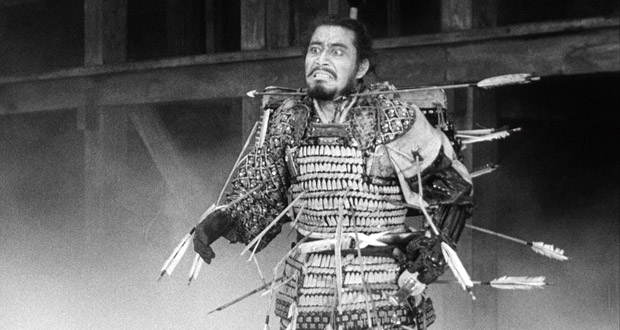
Written by Hideo Oguni, Shinobu Hashimoto, Ryûzô Kikushima, Akira Kurosawa, and directed by Kurosawa, “Throne of Blood” is an adaption of Shakespeare’s “Macbeth” set within feudal Japan, the film would lay the groundwork for Kurosawa’s later historical epics “Kagemusha” and “Ran” specifically. Here, once again, we have one of Kurosawa’s favorite leading men in Toshiro Mifune as Washizu, the titular Macbeth. After a successful battle, both Washizu and Miki (Minoru Chiaki), warriors and friends under Lord Tsuzuki (Takamaru Sasaki), return to his castle in ‘Spider’s Web’ Forest. On their way there, they encounter a ghostly spirit who tells them their future, Miki will be made commander of the first fortress and that Washizu will be named Lord of the Northern Garrison that same day. The spirit also tells them that Washizu will eventually become the Lord of Spider’s Web Castle itself! Though, she also foretells that Miki’s son will be the next Lord of Spider’s Web Castle after Washizu.
After they return to the castle, both men are shocked when the spirit’s predictions come true and each are given their new titles. Later when Washizu tells his wife, Lady Asaji (Lady Macbeth here portrayed by Isuzu Yamada), she convinces him to hasten the second part of the witch’s prediction and kill Lord Tsuzuki himself when he next arrives. After some debate they agree and Lady Asaji helps to drug the Lord’s guards during a visitation while Washizu kills his superior in the night. They quickly frame and kill one of the guards, and Washizu is moved up the ladder for his deed in killing the Lord’s assailant. The rest of the film is a quagmire of beautifully orchestrated paranoia and guilt built upon Washizu’s acts and lies, especially once the power couple consider the other part of the prediction- that Miki’s son would follow Washizu as the ruler of ‘Spider’s Web’ Forest Castle. Eventually Washizu seeks out the spirit of the woods once more for assurance as the suspicions and sleeplessness build upon themselves, and it expertly leads into the end sequence in which Washizu’s forces feed on his paranoia and end up killing him by a legion of arrows- his men had begun to harbor suspicions that Washizu himself was Lord Tsuzuki’s killer as well.
When it comes to Shakespeare, admittedly, I enjoy the themes and story structure of his stories (particularly the tragedies) but never from the actual source material itself. This is more of a personal taste issue, but the Olde English is deafening and cumbersome. I recently tried to watch “Henry V” from 1944 directed by Laurence Olivier, but I simply couldn’t get through it. So, I was looking forward to another adaption by Akira Kurosawa. Granted I watched both of his adaptions in “Ran” and “Throne of Blood” out of order, and that may have been a mistake on my part because while I certainly appreciated this film, I was never astonished or transported by the magic of cinema with this film. Thinking back on it, it’s a great adaption, especially with the great Toshiro Mifune in the lead role, but it wasn’t enough for me to Love it wholeheartedly as I did with “Ran”. This may also lie in the nature of this adaption and my taste in general. It’s a moody, atmospheric, tragedy littered with the themes of the source material of greed, political ambition, paranoia, and shame. It’s a damn fine film though and my own taste shouldn’t drive you away from a viewing.
Final Score: Dozens of Arrows!
*Here’s a link to a piece that Roger Ebert wrote about Akira Kurosawa shortly after his death in 1998, while it doesn’t have to do explicitly with “Throne of Blood”, it’s a good piece on the legendary filmmaker as a whole, and if you’ve come to appreciate Kurosawa’s work as I have, give it a read:
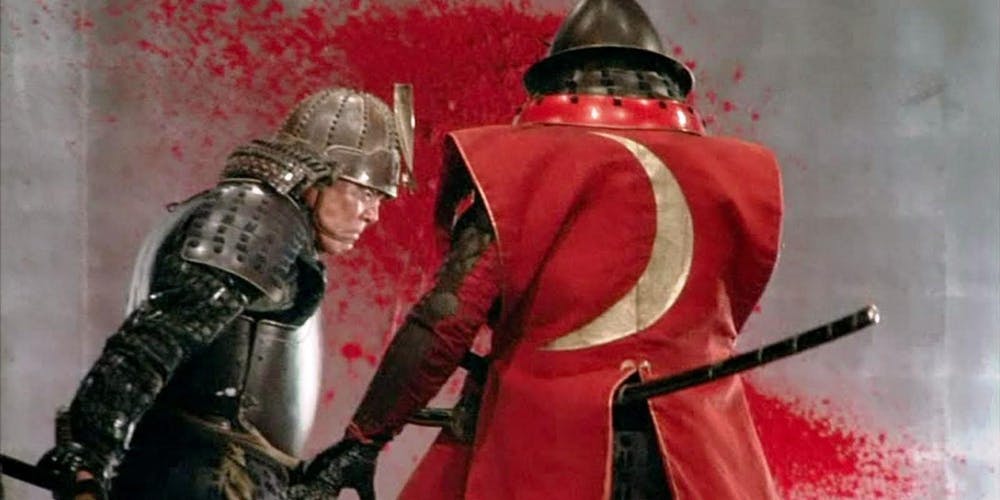
Written by Hideo Oguni, Masato Ide, and Akira Kurosawa, and directed by Kurosawa, “Ran” is an adaption of Shakespeare’s “King Lear” set during Japan’s medieval era in which an elder Japanese warlord seeks peace by dividing his kingdom among his three grown sons. Lord Hidetora Ichimonji (Tatsuya Nakadai) awakens from a vision after a hunt with his three sons and subordinate clan representatives, to which he decrees his own abdication from the throne. Stunned by the announcement, Hidetora’s three sons each react differently. Taro (Akira Terao), the eldest garbed in yellow, is set to be given the first castle while Jiro (Jinpachi Nezu) in red, and Saburo (Daisuke Ryû) in blue, are to be given the second and third castles in order of age and support Taro as the head of the Ichimonji clan. Taro, doesn’t even want the throne, while Jiro seeks it, and Saburo rejects the whole plan as one destined for failure. For his subversive outburst, Lord Hidetora banishes Saburo, and Tango (Masayuki Yui) the lord’s adviser, when he openly supports Saburo’s frankness.
I’ve been working through Akira Kurosawa’s filmography lately, and recently the Criterion Channel (The collection’s streaming service) added the legendary filmmaker’s late-in-career masterpiece to their ranks, and I figured I’d give it a shot. Knowing nothing about the film except that it was an adaption of “King Lear” proved to be a bountiful fortune going into the near three hour film. Of the seven, or so, films of Kurosawa’s that I have seen, this may be my favorite of the bunch so far- and that’s saying something with “Ikiru”, “Seven Samurai”, and “Yojimbo/Sanjuro” in that bunch! In doing some (very) light research before writing this review, I was surprised to find that Akira Kurosawa had trouble securing funding for this film for roughly a decade before it was finally released. Apparently Kurosawa had been going through a period akin to (but nowhere near as creatively apocalyptic) what Orson Welles went through after making “Citizen Kane”. After teaming with a French producer in Serge Silberman, the film found it’s foundation, and began winding towards one of the most engaging epics set within medieval Japan.
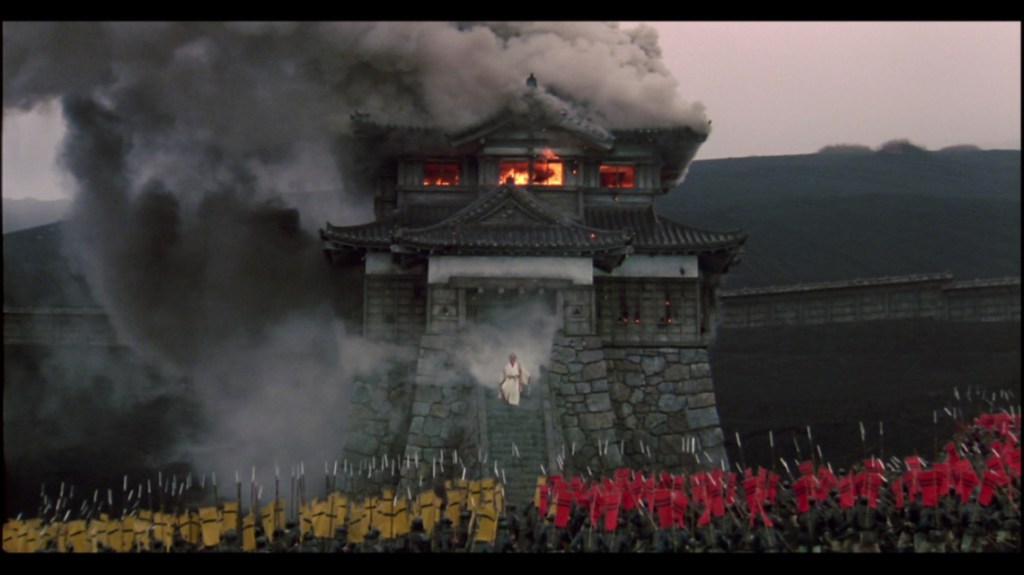
Having acquired most of his kingdom through brutal and ruthless tactics, this story is almost entirely about the consequences of Lord Hidetora’s actions and the ripple effect throughout his family as a result. After Saburo’s (and Tango’s) banishment things quickly go downhill for Lord Hidetora. As he moves into the smaller keep of the first castle he finds that Taro is being manipulated by his wife, Lady Kaede (Mieko Harada), into usurping Lord Hidetora after the transition of power to control the whole Ichimonji clan. Considering this an affront and needlessly offensive, Lord Hidetora takes leave of the first castle and heads to Jiro at the second Castle. There he finds himself to be more of a pawn in Jiro’s scheming than anything else. Broken by the betrayal of his sons, Lord Hidetora wanders off with his mercenaries and his fool Kyoami (Pîtâ) with no clear direction. Eventually Tango reappears with provisions to help the wandering party, but when he tells them of Taro’s new decree ‘to kill anyone found helping his father‘, they make a last ditch effort to take Saburo’s castle and fortify themselves there. Saburo’s men happen to be leaving as the group arrives anyways, and it isn’t long before both elder sons come to siege the castle and usurp their father from power through death or submission.
The rest of the film plays out like a season of ‘Game of Thrones’. The siege of the third castle in particular is brutal and impeccably staged. Kurosawa’s use of extras as the armies of Taro and Jiro clash with their father’s skilled warriors is beautifully organized. The chaos and bloodshed feel epic all while Lord Hidetora’s mind is blended, madness ensuing from the shock of all that has come from his abdication of power. The layers of history and karma striking back at the Ichimonji clan from within are glorious and well designed. I won’t divulge all of the details of the plot here, but its just so damn good! The way the story keeps digging at Hidetora’s past and forcing guilt and shame upon him for all that he has done is exemplary- just when you think it can’t get worse, it does! I found everything about this film to be just magnificent. From the score to the pacing, to the scheming and manipulative power moves, and revenge against the entire Ichimonji clan were just perfect in execution!
Seriously, if you enjoy film- this is one of the all time greats and I highly encourage anyone and everyone to give this film a shot. I can’t give this film enough praise, and I honestly need another rewatch to fully indulge in all of the film’s nuances and complexities. It may be a long watch, but it’s more than worth the two hours and forty-two minute runtime.
Final Score: Three sons and countless regrets
*Below is a link to Roger Ebert’s review of “ran” and a video essay by the “Every frame a painting” YouTube channel discussing Akira Kurosawa’s use of movement in his films. Both are simply great and give more depth to the film at hand, enjoy!
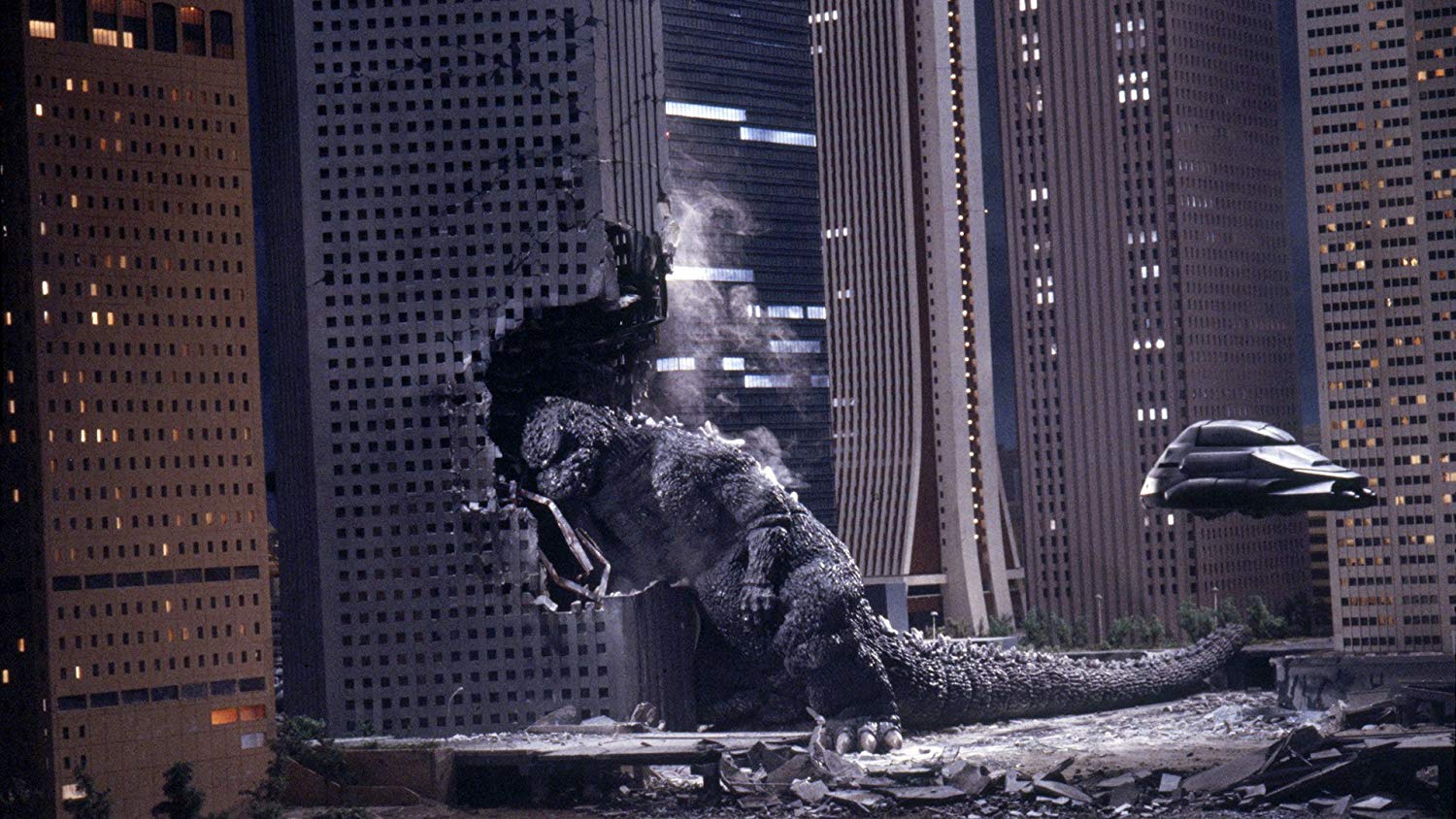
Written by Zach Shields, Max Borenstein, and Michael Dougherty, and directed by Dougherty, “Godzilla: King of the Monsters” is the sequel to the 2014 American reboot of the Godzilla property and the third movie in Legendary’s Monsterverse (Which includes Kong: Skull Island). Fast forward five years after the events of the first film, in which San Francisco was obliterated by Godzilla’s fight with the MUTOs, and we have the MONARCH organization keeping tabs on all potential “Titans” both known, and unknown. Returning are the MONARCH agents Dr. Vivienne Graham (Sally Hawkins) and Dr. Ishiro Serizawa (Ken Watanabe), but the focus this time around is on the Russell family. Dr. Emma Russell (Vera Farmiga) a leading MONARCH scientist, Mark Russell (Kyle Chandler) her separated and disillusioned husband, and Madison (Millie Bobby Brown) their daughter.
Now, to be completely clear, I am one hundred percent biased in this review. The Toho Godzilla movie series is a beloved thing in my household, even though there are a few misses in it’s sixty-five year history (I’m looking at you “Son of Godzilla”). From the 1954 original down through the goofy “Showa” series, and my personal favorite era; the Heisei films released in the mid 80’s through the mid 90’s, the big G has been many things to many people. Destroyer, savior, hero, or villain, Godzilla has always been entertaining, and never one to be trifled with. The practical effects and sci-fi B-movie goodness of these movies have always held a special place in my movie loving heart. Which is why this newest entry in the longest running film series had me excited for it’s potential Monster mash-up goodness. Though to be fair, I was wary coming into this film, the previous film in this latest American reboot of the property was more frustrating than anything else. There were some good things in Godzilla (2014) for sure, but I honestly couldn’t stand the lead character portrayed by Aaron Taylor-Johnson. He was so wooden and seemingly unaffected by everything happening around him, he had no sense of wonder, or terror, fear, joy etc, he felt muted and blank. Which was in stark contrast to Bryan Cranston’s character who was animated and motivated, propelled by heart and determination. Clearly, they had killed off the wrong character in my opinion. Those character choices combined with the head scratching decision to cut away from almost all of the Monster action left me in a daze walking out of the theater in 2014- everyone around me was proclaiming how great this new Godzilla movie was, but I felt none of their joy. Was I just getting too old for these things? Had I fallen out of touch with what made a good monster movie? What happened?
Which brings me back to “King of the Monsters”. This movie is an extreme departure from it’s predecessor, and it is a very welcome departure indeed. This is wholeheartedly a true Godzilla movie in every sense. Is it perfect? No, no it definitely is not- but did I have a great time watching it? Yes, I loved this film and it’s the only legitimately great American Godzilla movie in my opinion. This is clearly a movie made by people that love and respect the source material. Okay, so what makes it a great monster movie? Let’s break it down:
The Redesign of Godzilla
“King of the Monsters” came with a few changes to Godzilla, and they were all a move in the right direction. Not only was Godzilla slimmer for the sequel, but his spines that run along his back and tail were reverted back to the traditional shape that defined his look since the original. His spines now sport grooves that illuminate like the veins of a leaf before he bellows out his iconic blue beam of irradiated fire. However, most importantly, he sounded much closer to what he’s consistently sounded like for decades.
The Sound Design
Godzilla’s iconic roar may not have been as direct a translation to his Toho past as say “Shin Godzilla” was, but the filmmakers here clearly tried to infuse the roar that he had in the 2014 version with a more classic sounding undertone. In fact all of the main Toho monsters making appearances here sounded exactly like, if not very close to, their traditional sounds. Rodan’s titanic squawks were familiar, but Mothra’s chirps were pitch perfect and instantly recognizable. King Ghidorah’s gravity beams may not have had their static-y tones exactly, but everything else about his design and depiction was so good that it was easy to miss and forgive. The best aspect of the sound design and scoring of the film, in my opinion though, were the themes of each monster. Mothra’s theme was reassuring and gratifying, but the cream of the crop was Godzilla’s theme. Granted, it was the composer’s spin on his theme, but I was amazed we got that to be honest and it took place during the best rallying point in the movie- all was forgiven for that scene alone.
The Monsters and their Personalities
These giant beings have certain personalities attached to their grandeur, and the fact that each depiction of the four main Kaiju, err.. I mean Titans, was consistent with Toho’s canon was a dream come true. Godzilla’s dominance, King Ghidorah’s (or Monster Zero if you prefer, both titles are in the film) intense ferocity, Rodan’s eternal frenemy status with Godzilla, and Mothra’s divine benevolence all felt familiar and true to their usual character. All four Monsters were designed and showcased in grand fashion, and I’d be willing to bet that the latest renditions of these characters will be fondly remembered and beloved for some time.
The MONARCH organization Redesign and human cast in general
In the five years since the devastation of San Francisco, MONARCH must have been given a blank check from the government because they now have a multitude of worldwide bases and installations. They even have a giant airship that’s a combination between the imagery of the infamous US stealth bomber and the functionality of the “Super X” aircraft used in “Godzilla: 1985”. As for the human cast, they’re leagues above the last film. Dr. Serizawa has more to do in this film, notably I adored the fact that this film mirrors his actions in the original 1954 film, which both include the oxygen destroyer. Vera Farmiga’s wide-eyed desperation is serviceable and Kyle Chandler’s reserved hammy deliberations were appreciated- though I would have had him notch it up a peg or two. Admittedly Millie Bobby Brown’s character didn’t have anything particularly important to do other than be the emotional motivator for her parents and the rational actor in several scenes, but it wasn’t offputting either- just a bit underwhelming. My favorite human character (besides Serizawa) was Bradley Whitford’s Dr. Rick Stanton. Whitford’s dialogue was extremely hammy and it could most definitely be classified as overacting, but I loved every second of it. Some of you may deem it cringe-worthy, but in a giant monster movie- it works! I also thoroughly enjoyed Charles Dance’s no nonsense militarized villain of the film, he raised the threat level of every scene he was in- which is impressive given that he’s in a Godzilla movie.
So, if I had any drawbacks in the film, they would pale in comparison to the good things I have to say about it. For example, Rodan’s entrance in the movie is an exhilarating edge-of-your-seat sequence. His wings cause city destroying blasts of wind, he screams across the sky with his lava tipped wings grazing the ocean and destroys a multitude of military aircraft. Later in the film however, his power levels seem to be lowered, and he doesn’t feel as much of a threat as when he erupted out of a volcano. To be honest though, there’s not a lot of negative things I have to say about the movie. This film won’t be for everyone, and that’s okay, but if you enjoy big, loud, and fun summer blockbusters- then I’d be willing to bet you’ll have some fun with this one. I, for one, am amazed that this sort of film had a budget this size and was fairly true to the source material. Great job!
Written by Kôgo Noda and Yasujirô Ozu and directed by Ozu, “Good Morning” is a comedic drama following two young boys who wage a war of silence against their parents to persuade them to buy a Television set so they can watch Sumo wrestling. This is the most charming of Ozu’s films that I have seen thus far (three and counting), and still yet the film manages to insert powerful, but subtle, musings on the intricacies of communication and intent. The film is focused on a small Tokyo suburb of families living in close proximity with each other and it cleverly bounces between the language barriers and misunderstandings of a few groups of the residents. First, and most focused on, are the two brothers Isamu (Masahiko Shimazu) and Minoru (Sitara Koji). On their morning walks to school they and a few other boys from the neighborhood have perfected a game in which they press a finger against each other’s forehead to instigate a fart, which gives way to laughter and affirmation in the group. Funnily enough, one poor kid keeps failing this intestinal test and, well, he begins and ends the film with a walk of shame back to his parents to get a change of pants.
The mothers and wives of the suburb turn a simple misunderstanding into a series of gossip and rumors because their collective dues haven’t been paid accordingly. They all attest to have paid on time, surely, there was a simple issue along the way, but on the other hand the chairwoman, Mrs Haraguchi (Haruko Sugimura) who collects the dues, has just bought a new washing machine. As the film progresses, Mrs Hayashi (Kuniko Miyake) the mother of Isamu and Minoru, wanted to solve the issue quickly- she seems to be easily put on edge by financial stress– but Mrs Haraguchi hears about the allegation of a new washing machine bought illegally with the dues and confronts Mrs Hayashi (who didn’t even start the rumor) to assure her that this did not happen. Ironically, later when Isamu and Minoru go on a strike of silence to get their parents to buy a TV, they apply this silence to all adults and Mrs Haraguchi assumes this slight was instigated by Mrs Hayashi for the misunderstanding, and quickly informs the other women that Mrs Hayashi holds grudges. This whole incident, by the way, is finally uncovered when Mrs Haraguchi discovers that the dues were given to her mother (Eiko Miyoshi), a comedic old woman who had simply forgotten about receiving them. The grandmother is often found praying, and blatantly complaining about her ingrate of a daughter- yet another Ozu familiarity in the comedy and tragedy of generational family affairs.
The fathers and husbands of the suburb also have their own issues with communication as well. The father of Isamu and Minoru (Chishū Ryū) must mediate and absolve his sons squabbling, after they loudly resist he bellows that “You talk too much for boys your age”. Minoru (the eldest) responds that adults are even worse because adults always engage in pointless niceties like “good morning”, “good evening” and refuse to say exactly what they mean. Which is how Isamu and Minoru come to their silent strike. Their father also has a scene with an older acquaintance in a bar who had found no solace in retirement, only the slow walk toward death. They try to communicate between one’s drunken rambling and the other’s botched attempt to cheer him up- but in doing so realizes his own encroaching retirement. It is this acquaintance, happier with a new job near the end of the film selling electronics, that Isamu and Minoru’s parents buy a TV from to celebrate his new job- to the joy of the silent little warriors.
Written by Hideo Oguni, Eijirô Hisaita, Ryûzô Kikushima, Shinobu Hashimoto, and Akira Kurosawa and directed by Kurosawa, “The Bad Sleep Well” is a scintillating and scathing rebuke of the cut-throat, corrupt, climate that plagued Japan’s post-war corporations. Most of Akira Kurosawa’s films seem to fit into one of two categories, either his films take place in feudal Japan where Samurai and warring city-states engage in bloody battles, or they’re in the modern day Japan of it’s time and focus on the issues of the day, usually placing a heavy hand on the scale of morality. “The Bad Sleep Well” falls in the latter category and pulls a lot of it’s imagery and style from the American Noir crime genre. This time around, Kurosawa plays with a loose adaption of Hamlet set against the shadowy world of corporate espionage.
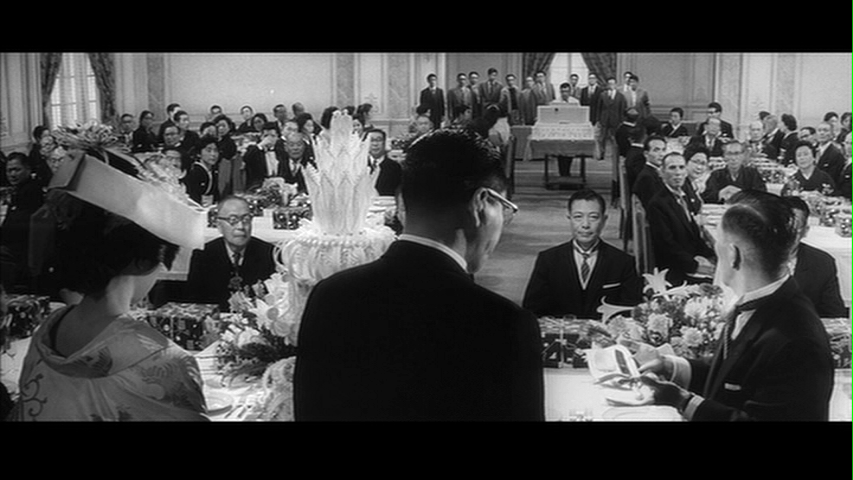
Though he may be mute for the first half hour, we’re eventually introduced to our lead in Kurosawa’s frequent collaborator, Toshirô Mifune as Kôichi Nishi. Mifune enters here with less swagger than Sanjuro or Yojimbo, but trade his usual aloofness for a pure and focused sense of revenge and Mifune’s Nishi transforms into a modern day, clean-shaven, Ronin in a three piece suit. His quest is to avenge his late father, who was forced to jump out of a window of the corporation building he worked in to safeguard his superiors and make it look as though he had committed suicide. The film opens with Nishi’s wedding with the daughter of the vice president of that same company, an unwitting innocent of collateral damage in Nishi’s shadow war against the powerful. In the wedding we’re introduced to the majority of the supporting players of the film as Nishi’s well researched scheme come to bits of fruition. Several potent accusations against leading members of the company (which lures the ravenous media to follow the high profile wedding), leads to the police arriving to take several high ranking board members in for questioning- but there’s also a large wedding cake brought in that’s an exact model of their corporate building, with a rose in the window that Nishi’s father was forced from. A perfect storm of shame and attempts at saving face for the company, which is played for comedic effect in brilliant form by Kurosawa.
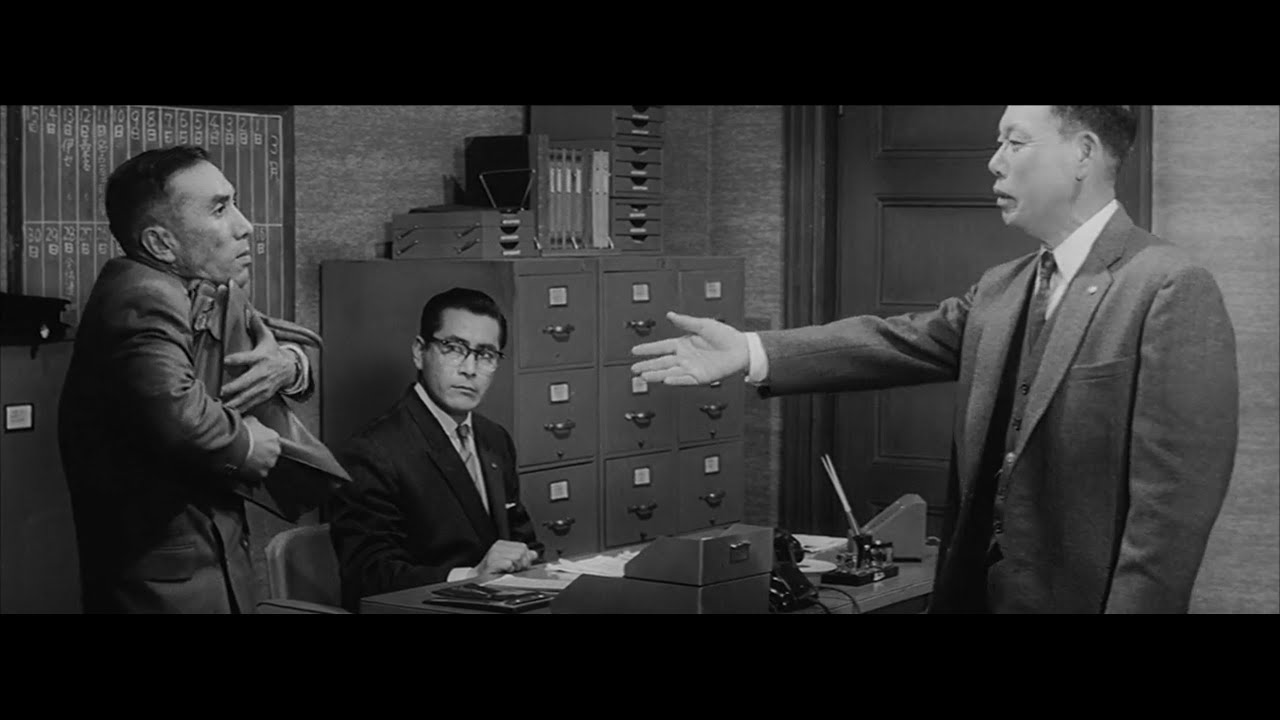
It’s a good note to start out on considering the dour realities of the third act. In fact, until about the last twenty minutes of the film, it seems as though Nishi’s carefully calculated plans will have won the day. But I’m getting ahead of myself, the majority of the film is spent with three figures of the Dairyu company reacting to the scandals erupting around them as they act to diffuse and smother the growing ramifications of their destructive deeds. After the wedding, Tomoko Wada (Kin Sugai) returns from weeks of questioning by the police only to be given orders from his superiors to jump into the nearby volcano and resolve them of his misfortune, but Nishi stops him, and converts him to the side of justice. With Wada’s help, and his covert partner Itakura (Takeshi Katô), the three set forth a plan of attack consisting mostly of using the ghost of Wada to horrify and panic Shirai (Kô Nishimura), the official that held the most sensitive secret information. The next rung up on the corporate ladder belongs to administrative officer Moriyama (Takashi Shimura) a more unflappable and calculating underling of vice president Iwabuchi (Masayuki Mori), the major player of the film. Who just so happens to have Nishi as his ever present assistant, plotting the downfall of the Dairyu executives that organized his father’s killing.
Eventually, Moriyama deduces that the only factor relating to all of their troubles is Furuya, Nishi’s father. Further digging reveals Nishi’s true parentage, and while Nishi captures Moriyama for a time in the ruins of a bombed out factory from World War Two, it is too late- Moriyama had already informed Iwabuchi before being captured. There’s a bit more to the story, but that’s the essential facts of it. Nishi’s found out and killed off-screen before we even know what’s happened, and Iwabuchi restores order to the Dairyu corporation- even if it means the death of his daughter, and his own son’s rejection after discovering the truth. It is a cold reminder that fighting against the machine can be frought with peril, and sometimes, people get caught in the grinding gears. With a pensive and sobering tone, one of Nishi’s last lines after discovering his true lack of progress against the corporation was, “I guess I don’t hate them enough“…
Final Score: A 7-story plummet
*Linked below are two more sources on the subject, the first is the YouTube channel, “Every Frame a Painting”s video analysis of Kurosawa’s use of geometry concerning the blocking of Actors in the film. The second is a piece of well written analysis of the film from the Criterion Collection. Enjoy!
Warning: Spoilers for “Chapter 2”, but not “Chapter 3”
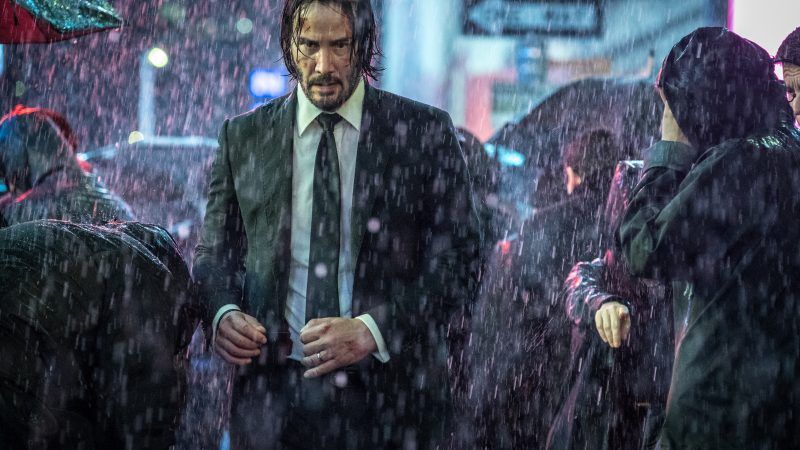
Written by Derek Kolstad, Chris Collins, Marc Abrams, and Shay Hatten and directed by Chad Stahelski “John Wick Chapter 3: Parabellum” is the third entry in the John Wick series which finds the titular Wick (Keanu Reeves) right where we left him at the end of the last film; which is to say, running for his life with his dog at his side. For those needing a refresher, the second film established the world only hinted at in the first film, wherein there are rules for the initiated- and those rules are taken with a deadly seriousness. The first rule, is that you may not conduct “business” on continental grounds. The Continental, being the internationally recognized hotel for assassins. The second rule is that once bound to a marker, you must oblige the bearer of any request they make. Markers are circular discs that open to two halves, one side is red with the blood of the needing, and the other is only imprinted with the blood of the subservient once the request has been completed. Once you ask someone for help with a marker, and they accept, you must know that you will have to repay them eventually. “Chapter 2” establishes the severity of not adhering to the will of a bearer with a marker binding you to them. Wick is forced into assisting a bearer in “Chapter 2” and seeks retribution once the task is completed- but kills the bearer on continental grounds and thus labeled Excommunicado with a heavy bounty placed on his head, though the Continental’s manager Winston (Ian McShane) gives Wick a one hour grace period before the contract is open to all known assassins.
You can’t see the dog from the last film here, but trust me, he’s there.
With a $14 Million price tag on his head, Wick scrambles to make it out of the city, but also by getting his dog to the continental where he knows they will take care of him. The first twenty minutes of this film have some of the most inventive and rollicking great action sequences since “The Raid: Redemption” took the action genre by storm eight years ago. Speaking of that film, there are a handful of actors that make the jump to this series for a few particularly formidable foes that Wick must tango with. In fact, one of the best aspects of this film, aside from the crazy-violent and gut-wrenching action scenes, are the multitude of cameos from a variety of sources. The first fight in the film is between Wick and “Ernest”, the 7 ft 3 in tall assassin played by Serbian NBA player Boban Marjanovic, in the New York Public Library. It’s an excellent fight to kick the movie off, it may have been a little short, but wow- I didn’t know you could do THAT to someone with a book! We also get cameos from Jerome Flynn (famously played Bronn in Game of Thrones) and Jason Mantzoukas (He played Rafi from “The League”) as one of the many homeless citizens in league [ba dum tss- I’ll see myself out] with The Bowery King once again played magnanimously by Laurence Fishburne. Of course I’d be negligent in my reviewing duties if I forgot to mention Tiger Hu Chen. Not only has he previously starred as the lead in the only film that Keanu’s directed himself in “Man of Tai Chi” (check it out, it’s fun!) but he also has the goriest death in this film, in my humble opinion.
As with the previous two films, the action in this series is increasingly inventive. If you’ve ever read or seen an interview with the director, Chad Stahelski, you’ll see that he has a deep love of the action genre and cinema as a whole. In both “Chapter 2” and this film the opening scenes pay respect to Buster Keaton in homage to his legendary stunt work in the 1920’s, by playing his work projected on the side of a building and on one of the many large screens in Times Square. Stahelski has thrown in a multitude of nods and winks to cinema’s past and many eagle-eyed, and knowledgeable, fans will catch them. A particularly fun one is when Wick breaks into an old antique gun shop and has to modify two guns into one quickly enough to get one shot off as his pursuers break the door down. The director himself has stated that that shot was a direct callback to “The Good, The Bad, and The Ugly” with Eli Wallach, putting a pistol together in the gun shop.
While the plot in films like these isn’t always the primary concern, this series knocks that notion off it’s feet by continually expanding on the lore and mythology behind the assassin’s organization by examining how it works, it’s many hidden layers, and who controls whom. I don’t want to get into too many spoilers since the film’s still in its opening week, but admittedly, this one does a great job at giving us morsels of information, like John Wick’s real name for example, and some understanding of where he came from and how he was molded into The Baba Yaga.
This is another excellent entry in the franchise and personally I had a great time with it! The action was superb, satisfying, and mystifying! The cast was well rounded and precise given the runtime, no one felt wasted! However the very best news that this film could give, was that there’s even more Baba Yaga to come! The fourth film has already been greenlit and given a May 2021 release date according to several movie news outlets, and nothing could have made this action fan happier to hear!
Final Score: 7 cuts!
*Here’s a fun interview with the director on the stunt work in the film (though it does contain spoilers!):


















 spacecortezwrites