This latest edition of the Rapid Fire Reviews is all about catching up with films I’ve had on my “To Watch” list for far too long. At least, most of them. “Tokyo-Ga” and “Odds Against Tomorrow” just happened to be films whose descriptions caught my interest and were captivating enough to be included. The other films come from some of my favorite filmmakers, though truly the handful of names included this time around are some of the most well known and beloved filmmakers in world cinema history. Akira Kurosawa, Ingmar Bergman, Jean-Luc Godard, François Truffaut, and Agnes Varda fill out the majority of this article, and the selected films are some of these celebrated Directors’ finest works. It was a truly mesmerizing way to spend a month this winter!

Tokyo-Ga (1985)
Written and directed by Wim Wenders, “Tokyo-Ga” is Wenders’ cinematic love letter to all things Ozu. To be clear, Wenders made this diary-styled documentary during his time in Tokyo in the spring of 1983, where he spent his days wandering and wondering if there was anything left of the world that famed Japanese film director Yasujiro Ozu had depicted across his 54 films. The majority of his films were made in Tokyo and often depicted the inherent drama of everyday life. One of the distinctive features of Ozu’s master period of his filmmaking were his “Pillow Shots”. These were short, static, shots of Tokyo as traffic, trains, or boats leisurely rolled through the shot. Occasionally these were active, narrow, alleys with many shops and bars, or repeated locations during the night’s slow and peaceful periods too. In this film, Wenders fills many somber shots of similar style, though the rebuilt and more frantic city life of 1985 Tokyo never quite recaptures Ozu’s notes of melancholy urban life and the upheaval of the traditional Japanese family life that were the subject of most of his films. It was a good effort though! Wenders isn’t here simply to recreate Ozu’s pillow shots though, he also interviews Chishu Ryu, Ozu’s leading man for many of his greatest hits, and Ozu’s cinematographer Yuharu Atsuta. They’re touching and emotional recollections of Ozu’s directorial style and the respect these men still held for him twenty years after his death. As a fun aside, Werner Herzog also appears in the film and has a short scene with Wenders, a good friend, at the top of Tokyo Tower in which he laments the lack of pure images in the urban landscape. It’s a delightful little film that’s full of heartfelt nostalgia, melancholy atmosphere, and curiosity explored. Highly recommended.

High and Low (1963)
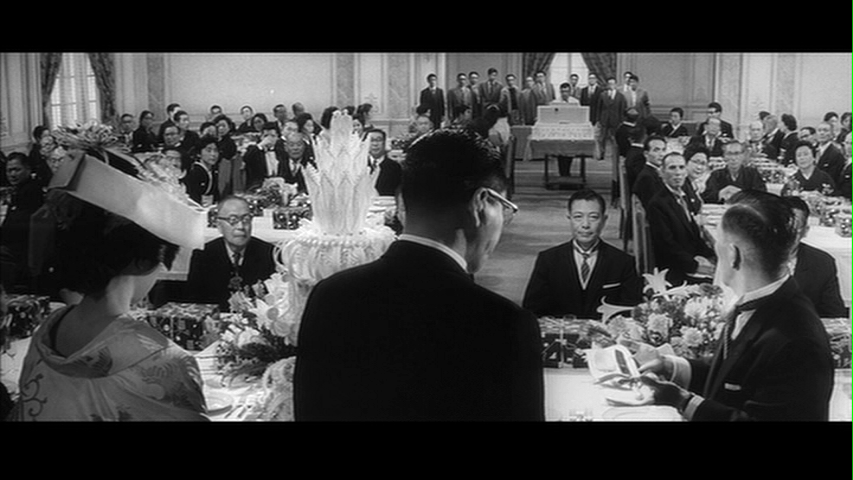
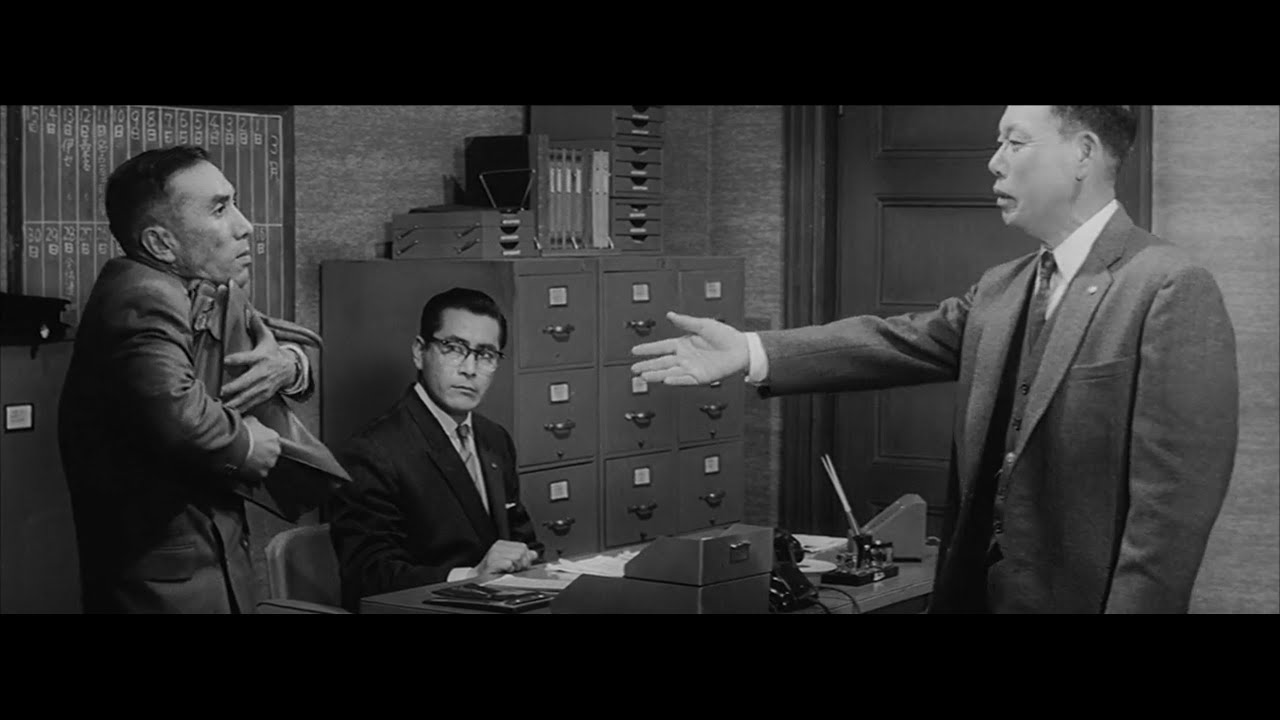
Written by Hideo Oguni, Ryûzô Kikushima, Eijirô Hisaita, and Akira Kurosawa, and directed by Kurosawa “High and Low” is an adaption of the novel “King’s Ransom” by Evan Hunter, who often wrote under the pen name of Ed McBain for his crime novels. I found this film to be cinematic perfection if I’m being honest. It’s a masterclass in direction, cinematography, and the visual geography of scenes. The film begins with several high level executives of ‘National Shoes’ who meet with Kingo Gondo (Toshirô Mifune) to persuade him to join their corporate coup d’etat to force the company to make cheaper shoes quicker in a bid to increase short term profits over the more expensive process that high quality shoes would entail. To their surprise Gondo has his own aspirations and has already horded stock in the company to better posture for his own argument that the craftsmanship and quality of their products is far more crucial than immediate profit margins. The executives leave in a huff and Gondo makes moves by calling around to buy just enough stock to take control of the company. Akira Kurosawa takes great effort to set up Gondo as a man of principle and respect in the opening scenes, and it’s something that rides throughout the rest of the film as the audience can sympathize with the situation he’s soon to find himself in. Amidst all this white collar drama unfolding before us, it’s almost jarring when the hook of the story bursts onto the scene as a kidnapper calls to inform Mr. Gondo that his son has been captured and demands a high ransom that would cripple his newfound position in the company. It isn’t long before Gondo’s son appears around the corner asking where his friend had gone off to, which prompts Gondo’s Chauffeur, Aoki (Yutaka Sada), to realize that it was his son that was mistakenly abducted. The kidnapper calls back after awhile as he realizes his mistake and demands Gondo pay the price anyways. From there the film turns into a police procedural with Gondo disappearing almost entirely from the proceedings until much later in the film. It’s thoroughly engaging, full of well executed suspense, with unexpected evolutions throughout the remainder of the runtime. This one was one of the best films I have seen in a long time and I highly recommend giving it a watch, it’s great!
For more analysis on this film, check out the following article on the Criterion Collection’s online magazine, The Current, at the link below:
https://www.criterion.com/current/posts/515-high-and-low-between-heaven-and-hell

Pierrot le Fou (1965)
Written by Rémo Forlani and Jean-Luc Godard, based upon the novel by Lionel White, and directed by Godard, “Pierrot le Fou” is the first film from Godard that I’ve found myself quite enjoying. I’ve been slow to watch more of his work because each one that I have gone out of my way for has left me in a state of confusion and an utter lack of interest. That changes with “Pierrot Le Fou”. I see this one as the far more interesting version of “Breathless”. Maybe it’s because Godard engages, in an articulate sense, with American genre in a number of scenes that string together a narrative more functionally. At least, that’s how it feels to me. It’s also a far more relaxed and playful film even though the main characters galivant across France committing crimes with the film ultimately ending in a murder-suicide. It sounds strange writing it out that way, but Godard’s films always seem to have that side-effect of being hard to describe in the normal realm of film reviews. The opening scenes in Paris depict Ferdinand Griffon dit Pierrot (Jean-Paul Belmondo) living unhappily with his wife in high society. They head out to a party that Ferdinand doesn’t even want to go to wherein Godard criticizes and mocks what I can only describe as “Advertisement Speech” where patrons of the party talk to each other as if they’re in a commercial. It seems more like mockery than an off creative choice, and I quite enjoyed the sass of that scene. If this is your first film with Godard, his style of oddities may seem abrasive at first, but trust me, this is a good one. Definitely recommended.
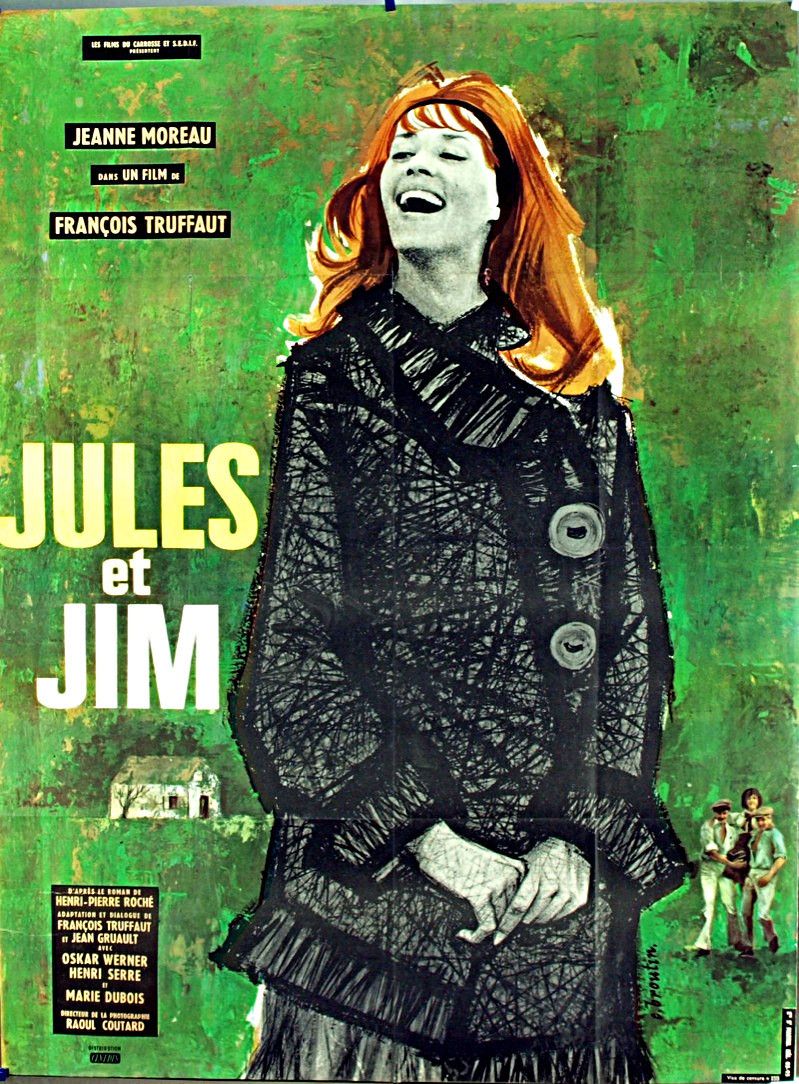
Jules and Jim (1962)
Written by Jean Gruault and François Truffaut, adapted from the novel by Henri-Pierre Roché, and directed by Truffaut, “Jules and Jim” is considered, like “Pierrot le Fou” above, to be one of the highlights of the French New Wave. Between Jean-Luc Godard and François Truffaut, so far I’ve vastly preferred Truffaut’s films. Truffaut seems to be more apt to explore a character’s emotional drama and he’s less inclined to edit and write as abstractly as Godard. With “Jules and Jim” Truffaut takes his exploration of interpersonal relationships to the next level. The story begins in Paris a few years before World War One when the titular Jules and Jim meet and quickly become friends. The two bond over literature, art, physical skill in boxing and fencing, and of course, discussions of women. Jules (Oskar Werner) is a shorter, blond, and quiet writer from Austria, while Jim (Henri Serre) is the more extroverted Parisian. He’s taller, lankier, and less troubled than Jules overall. Though while these two share the title of the film, the star of the show and character that moves the plot the most is Catherine (Jeanne Moreau). In an inspired choice, the arrival of this ever evolving presence in the lives of Jules and Jim is foreshadowed by the two seeing a mesmerizing ancient bust of a Goddess during a slideshow. Both are so taken by the smiling figure that they track down the actual bust to see it for themselves. It isn’t long before Catherine enters the picture, and her presence is even more alluring to them than the goddess of stone before her. Her strong sense of self is as grandiose as it is mercurial. Later in the film, under a vastly different context, Jim tells Catherine that he understands her, to which she quickly bemoans, “I don’t want to be understood”. This perfectly captures how she interacts with those closest to her, and broadly the world around her. The films spans quite a longer period of time than I had expected going into it, as the story traces the characters lives before, during, and after World War One. The circumstances of the time meant that each friend was on the opposing side of the war, both often fretting over whether or not they could be shooting at a good friend. There’s a lot of change that takes place between the three of them over the course of the film with Catherine marrying Jules, becoming unhappy with his boring stability, taking on Jim as a boyfriend while Jules just wants to hold onto his love for her and their small daughter in any way he can. It’s a surprisingly complex love triangle, I certainly didn’t expect an examination of polyamorous relationships in a foreign film from the early 1960s! While not my favorite Truffaut film so far (Currently it’s “Shoot The Piano Player” https://spacecortezwrites.com/2020/02/11/old-school-review-shoot-the-piano-player-1960/), but it’s a fairly good film and one I do recommend seeking out!
For more analysis on this film, check out the following article on the Criterion Collection’s online magazine, The Current, at the link below:
https://www.criterion.com/current/posts/369-on-jules-and-jim

Vagabond (1985)
Written and directed by Agnès Varda, “Vagabond” is a story that’s mostly fictional, but partly a documentary too. As the story revolves around people living a nomadic life in rural and urban environments, some of the cast actually are nomadic people in real life. Agnès Varda’s voiceover in the beginning of the film serves as the structure of the story for the remainder of the runtime. Which is important as her unseen reporting elicits responses from a variety of people who met and knew Mona Bergeron (Sandrine Bonnaire) in the several weeks preceding her death. Yes, the film opens with the discovery of Mona’s lifeless body, having frozen to death in a ditch overnight near a vineyard. In this way, the film sets up it’s structure incredibly close to how the story in “Citizen Kane” flows through the runtime. Though admittedly, I had not considered this similarity until the article I was reading on The Criterion Collection’s online Magazine, The Current, had mentioned it. I also didn’t think I’d be linking most of the films here to a more in-depth analysis through The Current, but here we are. Throughout “Vagabond” Mona moves from place to place seeking food and shelter, though what becomes clear over time is that she has outright chosen this lifestyle for herself, part of a greater ideology it seems, but we’re never given a large amount of details about it. Though that’s not really the point of the film. Mona interacts with virtually every slice of French society throughout this time. She camps out in fields with her small tent, lives in a mostly abandoned French Chateau with another urban nomad, she even finds herself living with the seasonal Arab migrants who work on an expansive vineyard- though not for long. My favorite stop on her journey was when she was allowed to stay with a maid who serves a rich older widow who lives quite nicely. Mona ignores the maid’s warning about the wealthy Grandma and instead hangs out with her as they both get drunk together. It’s legitimately heartwarming. This is the second film I’ve seen from Agnes Varda, and I have to say, I absolutely love how she control’s the camera’s eye. It showcases curiosity behind the camera, and a willingness to film the inherent drama of normal people’s lives. I also quite enjoyed the side cast of characters surrounding Mona. Initially it seemed as though we would only get snippets of these strangers lives and never see or hear from them again, but not so! Many of the people Mona meets are reconnected by relation or connections to other new characters in a variety of entertaining ways. While the beginning and end of the film are tinged in a melancholy sadness for the entirely avoidable death of Mona, the film does evoke a lust for life through the people Mona meets on her trail. It doesn’t always go well for Mona, but it’s certainly a story worth telling and worth watching. Definitely recommended.
For more analysis on this film, check out the following article on the Criterion Collection’s online magazine, The Current, at the link below:
https://www.criterion.com/current/posts/78-vagabond

Persona (1966)
Written and directed by Ingmar Bergman, “Persona” is one of those films that feels indescribable at first. At first glance, the film is about an actress who has become mute, and the nurse assigned to help her through this silence and tend to her needs. The actress is Elizabeth (Liv Ullmann), a well known performer who mysteriously became mute in the middle of the stage production of “Electra”. The psychiatric Nurse is Alma (Bibi Andersson), a talkative and warm presence who is the polar opposite of Elizabeth as we shall come to see. I’ve done some digging into this film, and there are a variety of ways to absorb the story. There’s the completely viable method of understanding the film as it is literally shown to us, but there’s plenty of depth there if you’re willing to look for it. After the initial round of therapy at the Hospital in town fails to produce productive results Alma’s superior suggests the two of them head to the good doctor’s summer retreat on a sunny island for a month or two to better facilitate an environment for Elizabeth to recover in. Once on the island the two continue to move forward hoping for Elizabeth’s mental health to improve. Over time Alma begins to become comfortable around Elizabeth- eventually enough to reveal a personal story of sexual infidelity while engaged to the man that would become her husband. We find that while Elizabeth is married unhappily, she also bore a son whom she did not want, whereas Alma successfully aborted her unwanted child from her beach encounter. There’s a whole lot to dig into with this film, from the beginning of the film which opens like an old silent film, there’s even a meta shot at one point of Bergman and the crew sitting at cameras looking back. It’s all quite dreamlike to be honest. There’s speculation that both Alma and Elizabeth may be two parts of one person, especially with the camerawork done to superimpose half of each Actress’ face to form an unsettling new face in one shot. It’s abstract and ethereal, it plumbs psychology and plays with the fabric of its own reality. It’s definitely one you should watch if you’re making your own “Film School” of sorts by thoroughly flipping through cinema’s history to learn more about the craft itself. It’s a weird one, but most definitely worth your time! Give it a shot!
For more analysis on this film, check out the following archived review from Roger Ebert, at the link below:
https://www.rogerebert.com/reviews/great-movie-persona-1966

Odds Against Tomorrow (1959)
Written by Nelson Gidding and Abraham Polonsky, based on the novel by William P. McGivern, and directed by Robert Wise, “Odds Against Tomorrow” is first and foremost, a film of it’s era that still holds lessons for audiences today. This Noir heist film is one that also has a societal message underpinning it’s genre sensibilities. The title and theme of the film is that if we can’t take the time today for a little more patience and understanding of our fellow man, our neighbors, then the Odds Against Tomorrow will be a price too high to achieve. The three main characters of the film begin with Johnny Ingram (Harry Belafonte) a nightclub singer who also has a bit of a gambling problem at the horse racetracks, Earle Slater (Robert Ryan) a racist fanatic whose performance should make any audience’s flesh crawl with disgust, and Dave Burke (Ed Begley) a former Cop that was fired in disgrace for corruption charges. Burke organizes the whole operation, he brings in Ingram and Slater separately to show them each the details of the heist before putting the two lit fuses in the same room together. It’s a simple heist that relies heavily on the trust of each participant, and when this uneasy alliance begins to crack, things get dicey for everyone involved. This one was thoroughly entertaining! The actual heist is taut and engaging with each character’s performance leading into the main event layering each moment with potential instability. It’s definitely worth a watch, especially if you enjoy crime genre sensibilities.
I’ve also been writing Film Criticism over at Films Fatale. Check out the links below and show them some love!




 spacecortezwrites